Showing posts with label friends' modelling. Show all posts

Tuesday, 6 July 2021

Clearing Shelves

When I changed scale to 1/19 I sold most of my 1/35 scale models to fellow modellers around Europe. I kept some as they were simply too nice to let go, while others were planned for exhibition purposes. The chance of getting models exhibited seems pretty slim within the nearest future and recently I was wondering how best to dispose of a few models. My 1/19 scale models take up a lot of room and let's face it: I'm not going to find use for my remaining 1:35 models any time soon.

My 1:35 Italeri BMW motor cycle parked in front of a small garage. Once the MC served Nystrup Gravel, now it earns its living on roads in a 1:35 version of Luxembourg. One of the models disposed off in late 2018.

A fellow modeller in Denmark has begun to show interest i 1:32 scale and as I know him to be a dedicated modeller showing great appreciation for old things (he's even working as a museum's curator), I decided to turn over a few models for him to take care of for the future.

I had a range of models that fitted exactly in the era that he models in. Some of them were equipped with wood gas generators only in use during his 1940's period of modelling, so I guessed my donation would be appreciated. I wasn't wrong and quickly a short meeting was set up and the models changed owners. I even got a bottle of Tranquebar Royal Danish Navy Gin in exchange and I must admit that the gin tastes far better than any railway model I have tried so far!
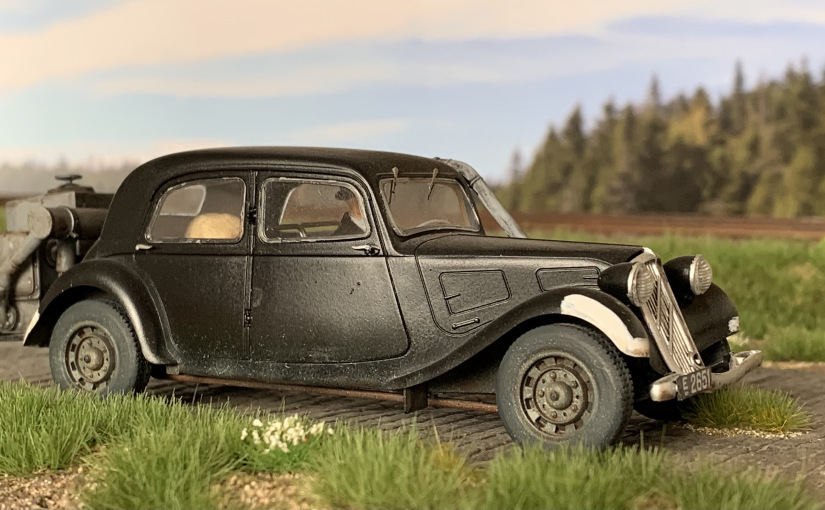
My 1:35 Citroen Traction Avant registration number E 2651 photographed by its new owner on his modular system of photo planks and backgrounds. 

See more images and a short description of the Citroen on my friend's modelling blog in Danish. It wouldn't surprise me if other models with a past on Nystrup Gravel should show up in the coming months.

The morale of the story is, that if you want your models to live on after you have finished with them, just ask if anyone wants them. If they aren't instant sellers and can't bring in cash for new projects, then pass them on to other modellers which may have use for them. Definately a better solution than throwing them away.

Wednesday, 16 December 2020

Road Vehicles Around Nystrup Gravel

Anyone having read more than a few posts on the Nystrup Gravel blog will have noticed that road vehicles play a large role. While it is the narrow gauge railway that is the main focus in my modelling, road vehicles are a great way to set the railway in the right period. Many Danish industrial railways used the same loco and skips for a period of 40 years. Apart from new damage, a fresh paint job or more dirt and wear, a train could look pretty much the same in 1979 as it did in 1950. On the contrary, road vehicles changed design almost constantly and are consequently a much better indicator of which span of time my little railway is set in. And let's face it, some road vehicles are almost as cool as trains and help create nice little scenes on any layout.

A new delivery of coal to Nystrup Gravel. Delivered in a much rebuilt Ford-lorry in 1/35 scale.

Experienced exhibitors also mention that visitors that are not hardcore railway enthusiasts enjoy non-railway layout features as much as the railway stuff. I think I'm like that myself. When I considered changing scale from 1:35 to 16 mm scale I made sure that a decent selection of cars from the first half of the 1950's was available. I wouldn't think of testing a new scale without checking out if any cars were available.

I know other railway modellers with a keen interest in road vehicles. I'm always exited to see what stories the Sundborg-blog presents, as the author does well researched posts on cars from the 1950's. The number of Sundborg-posts on cars is even larger than on my Nystrup Gravel-blog. It's a great inspiration and has more than once been a deciding factor on which cars to run on the narrow roads around Nystrup.

While I was modelling in 1:35 scale many commercial vehicles could be converted from the wide range af military soft skinned vehicles available as kits in injected plastic or resin. Some civilian vehicles also surfaced with regular intervals, as the scale developed from a pure military focus.

A Bedford O tipper from Vognmand Hansen crossing the viaduct taking the road over the Nystrup Gravel line. The model is a 1:35 scale kit in resin and white metal from Roadcraft Models.

A Commer tractor unit with trailer loaded with Schöma locomotive. The Commer is a resin kit Wespe Models, while the trailer is a resin kit from RB-models. Both kits were detailed and fitted with custom decals.

Cars weren't as widely available in 1:35 scale as lorries, but I found some quite good kits and they provided me with many opportunities to create Danish cars from the first half of the 1950's.

A tiny Tamiya Simca 5 built basically out of the box. A lovely kit and very easy to assemble.

My little Cushman scooter built from a Plus Models resin kit. A rather fiddly kit, but looking great on a summer evening.

Contrary to 1:35 scale most car models in 1/19 scale are diecast and sold pre-assembled. Actually most of the cars are 1/18 scale, but they can be used in 1/19 scale without any noticable disadvantage. They are detailed in varying degrees and they all benefit from a certain treatment with added details, Danish license plates and detail painting and weathering. The custom designed decals with company names and license plates help set the scene for Nystrup Gravel by building up a community with local businesses and personalities.

The best known clothes washing business in Nystrup was Lützows Lyn-Vaskeri with the characteristic two bolts of lightning on the sides of their vehicles. Here on a green Chenard & Walcker van from French maker Norev.

A good looking Volvo PV445 from BoS still without Danish license plates or other added Danish specialities.

With my current very small layout I have too many car models already. I'm planning for a Ford A lorry to be able to show a lorry being loaded with gravel at the ramp. Apart from that I may put my road vehicle expansion programme on hold for a while. Let's see if that is possible!

Wednesday, 18 March 2020

Rail Order in Transit for Nystrup

Based on my own research and advise from knowledgeable modellers I have now sent for six lengths of Peco IL-7 FB Code 143 rail. I added a few extra items for track building as I had the credit card out of the card holder. A month ago I reflected over the Peco SM32 track I had acquired for test running and designing my 16 mm scale indoor layout.

Not least the comments and subsequent mail from blog reader Nick Curtis assured me that the Peco Code 143 would be a good rail size for my experiments scratch building track in 1:19 scale.
Nick Curtis had just received his Code 143 rails and posed a few skips on them to illustrate the quite nice relationship in size to the Peco rail. Photo: Nick Curtis.
Not only the rail's height fitted my needs for a realistic type of rail for Nystrup Gravel. The profile is also a much neater representation of a Vignoles profile than my current standard Peco SM32 Code 200 track.
A close up of the IL-7 FB profile. A pretty good match for a real Vignoles profile. Photo: Nick Curtis.

I'm now looking forward to the package arriving from Germany. I shopped at Wenz-Modellbau where I also shopped track items when modelling in 1:35 scale.

A big 'thank you' must go out to anyone responding to my blog helping me to discover new methods, products and suppliers. A particular thank goes out to Nick Curtis for sharing info and images.

Monday, 5 March 2018

Gmeinder Locomotive for Arne Nielsen (1/35)

My good friend Arne Nielsen is running his 1:32 scale 16,5 mm gauge industrial railway to supply his standard gauge railway on the Danish Island of Langeland with firewood and oil. Occasional transports of building materials and machine parts are also known to be carried out on the little railway. Presumably the traffic is increasing as a new locomotive have arrived. I have told stories from Langeland before.
Arne Nielsen's new Gmeinder in curry yellow and dirt. Photo: Arne Nielsen.


Arne has invested in the Feld Grossbahn 1:32 scale Gmeinder 10/12. The prototype was the smallest type in a standardised range of locos from the German manufacturer Gmeinder from the city of Mosbach. A few Gmeinders came to Denmark during the German occupation, as many German contractors arrived to build air fields and fortifications. See a range of preserved Gmeinder locos here.


The model is made from metal and comparatively heavy for such a small model. Power pick up is from all four wheels and good pick up should be helped by the loco's three-point suspension. The motor is a Faulhaber and all bearings for wheels and driveline are fitted with ball bearings. The model is available as a ready to run-model, with or without decoder. When equipped for DCC sound and stay alive powerpack is included. Despite the small size of the model, Arne Nielsen notices that the sound produced is very convincing. Arne has described his first impression of the model with his own words in Danish here.
Gmeinder with a short train of rebuilt Bachmann-skips. Sacks with Nystrup Gravel 'Multisand' are visible on the flat wagon. Photo: Arne Nielsen.

The Feld Grossbahn model seen from the underside. The chain drive is clearly visible. Photo: Arne Nielsen.


The body of the loco is made from metal and makes a very sturdy impression. The level of detail is good, several of the parts being made from etched metal. The model can be ordered finished in several livery options and can be bought weathered directly from the manufacturer.
The Gmeinder meets the narrow gauge railway's old locomotive, the ASOA Henschel DG26. A standard gauge train is making a brief stop at Broløkke halt in the background. Photo: Arne Nielsen.

Monday, 28 August 2017

Modelling Inspiration

Ideas aren't coming from nothing. My inspiration comes from a wide range af sources. I have previously written about one particular book that has inspired me. In this post I will take you through a few other sources of inspiration.
A small narrow gauge peat railway in Klosterlund, Denmark. It's summer, the air is hot and I can almost hear the larch singing in the sky. The flowers are in full bloom and from the moor in the distance a little locomotive is pulling three simple wagons with peat over light and crooked rails. Behind the train you can just about see a few cows resting and enjoying the good weather. Just the kind of railway I love!

Obviously reality is a primary inspiration for me. Who wouldn't be inspired by the above photo? There are more great prototype locos and scenes than I can ever manage to model even if I lived to be 100 years.


Other modellers' work surely inspires too. I pick up that inspiration from several sources. The work of many talented modellers appears in Narrow Gauge and Industrial Railway Modelling Review and I honestly don't know where I would be modelling wise if that magazine wasn't available. A huge 'thank you' to editors, helping staff and authors. If you are not a subscriber, consider becoming one. Find out how to order a subscription here.
From my 'Review' collection. I'm still looking for issue 1. The open magazine is issue 47 with a briliantly written story of a small 0-16.5 slate quarry. Shows that inspiration doesn't have to come from one's own scale or theme.


However great a real paper magazine is, online inspiration can be found as well. A myriad of sites offer images, films and descriptions of real industrial railways (usually long gone, unfortunately) and advise on how to model them. The best I know is the NRGM-forum. You have to acquire a login, but that tiny trouble will repay endlessly. The forum is frequented by friendly expert modellers from all over our planet - some of them known from the 'Review'.


On my work bench I'm learning new things. Last evening I practised my weaving techniques as I was making revetments for my French artillery position. I used tooth picks and cheap wire from a hobby shop.
A short section of weaved revetment in 1:35 scale. My test worked out rather well. More sections are on their way.

Sunday, 29 January 2017

Langeland Narrow Gauge (1/35)

As I mentioned last week a few of my sacks with foundry sand had been sent to Langeland. On the island of Langeland a small machine shop was a regular user of Multisand. From the SG station a narrow gauge railway took the sand to the works. I have been fortunate to receive some images from Langeland showing just such a transport.

A narrow gauge train at the small halt Broløkke. The railway usually carried firewood. In the background a short standard gauge goods train. Photo: Arne Nielsen.
Loco driver Valde Marsen during some shunting at Broløkke. Notice the difference in size between the small Henschel DG26 and the brand new Danish State Railway's type Mh shunting engine. A lonely spectator apparently finds the narrow gauge railway the most interesting. Sacks of Multisand can be seen in the 3 plank open wagon. Photo: Arne Nielsen.
 
Crossing the large road between Pløresø and Arnborg. The crossing was a dangerous place and I hope the bicyclist will be able to avoid crashing into the little train. Besides foundry sand to the machine shop the train carries cement and tarpaper. Photo: Arne Nielsen.

En route the train stops at a siding to unload cement and tarpaper at a construction site. The row of new houses being built can be seen in the background. Notice the level of detail: There are mushrooms under the pine trees! Photo: Arne Nielsen.
Here's one of the sand trains at Nystrup Gravel. While the foundry sand was a profitable product, the deposits of sand were limited. By far the most usual train on the line was a train of skips loaded with gravel.

Despite modelling in a scale and theme not shared by many I'm lucky to have a few good friends modelling in 1:32/1:35 I can cooperate with. We send each other tips and share parts when we can. Most important we provide inspiration to each other and I benefit greatly by being 'pushed' to the modelling bench when I see the progress done by my friends. I have shared images from Arne's narrow gauge railway before. You can see more on this site from time to time, but be warned: most of it is Gauge 1, 1:32 and standard gauge!

Sunday, 6 July 2014

Narrow Gauge Progress at NLB (1/35)

Some time ago I mentioned that a ‘companion’ to my Nystrup Gravel is slowly being built in another part of Denmark. Although this narrow gauge industrial railway is in 1:32 scale (as it has to match the owners’ Gauge 1-layout called 'New Langeland's Railway' - Ny Langelandsbanen in Danish) I consider it very much a ‘partner’ for my own 1:35 railway as they share both gauge and theme. Recently there has been much progress on the layout. Not least around the narrow gauge line. My friend and his wife has done a lot of track laying and landscaping. While there is still some work left before the line is finished (will it ever be?), I thought I would share a few images with you. Notice that there is still being worked on the layout.
An overview of the narrow gauge terminus at 'Broløkke Halt'. From the woods around Broløkke firewood is assembled and stored to be transported to the standard gauge railway loco depot by narrow gauge railway. The difference in gauge is striking. Photo: Arne Nielsen.
The railway's single loco pulling a newly constructed tank wagon and two flats for firewood. The Henschel DG 26 is the ASOA-model in 1:32. The model has recently been re-released by ASOA with a new chassis from sb-modellbau. The standard gauge halt with its characteristic reinforced concrete building can be seen in the distance. The building is carefully scratchbuilt from a prototype on the Danish railway 'Langelandsbanen'. See photos from the real Broløkke Halt here. Photo: Arne Nielsen.


An innovative scenic break: A wood lined avenue separates the Broløkke area from the main station on the layout: Arnborg. Photo: Arne Nielsen.

The Henschel approaching the ungated crossing. Low speed and much vigilance from the loco driver are necessary when crossing the road. Photo: Arne Nielsen.
With the progress on the owners' home layout I wonder if they will have time left for work on their narrow gauge modules? Their modules can be attached to mine and share my fiddle yard as one end of our common line. We hope to make contact with a standard gauge module in the other end of the line. We are not co-running our modules often, but will be running trains of skips together at the next Gauge 1 exhibition in November.

Gauge 1 exhibition 2012: Almost 7 metres of industrial narrow gauge railway. Closest my fiddle yard (still very exposed and unpainted), next my three modules and in the distance the three modules supplied by my friend. I hope we can present a little more coherent look in November. At least I promise to paint the fiddle yard!

Friday, 16 August 2013

A New Danish 1:32 Narrow Gauge Railway (1/35)

The number of industrial narrow gauge railways in the scale range 1:35-1:32 is growing in Denmark. The increase is an impressive 100 % ! With a continued growth rate of that size, scale and theme will soon outgrow H0 in Danish railway modelling. Well, the facts behind the story is that the number of operations has gone up from one (my own) to two! For me it is great not being all alone in my hobby. (And just because the owner of this new narrow gauge line and I share surname we are not related, more than 260.000 Danes bearing the surname Nielsen.)

On a 1:32 Gauge 1 home layout far away from Copenhagen a small narrow gauge line is steadily growing. The line is owned by a standard gauge railway company and used primarily for transport of wood and coal to supply the standard gauge locomotives. The line is different from most of the very short systems with that task. This line runs from a wooded area where firewood is collected to the loco depot covering a distance far longer than most depot serving narrow gauge lines. The line has several unique features: a level crossing with a standard gauge siding and a small bridge over the point rodding to a point on the neighbouring standard gauge line, besides crossing a major road. A wooden loco shed has recently been erected.
A view over most of the narrow gauge line. The line ends by the buildings in the background. The wooded area will materialize later in the right hand side of the image. Photo: Arne Nielsen.


The DG 26 with a short 1:32 scale train of small flats and a Bachmann skip. The DG 26 saw service on my modules at the exhibition near Odense in 2012 and is an excellent slow running loco. Photo: Arne Nielsen.
So far there is one Henschel DG-26 diesel loco from Asoa and a few wagons on the railway. More may arrive in the future if traffic on the line increases. The narrow gauge line is being built with clever use of cheap materials. The tread plate ends on the Bachmann skip based flat wagons are made from scraps of packaging band (free) and the loco shed built from coffee stirrers (basically free, too). It proves that narrow gauge modelling in a large scale doesn't have to be expensive.


The loco shed during construction. Notice the neat wooden cladding possible with simple coffee stirrers. Scale lumber may be more exclusive but not necessarily much better looking. Photo: Arne Nielsen.
The newest information from the narrow gauge line indicates that major investments are due. A new loco, a bogie flat and a closed goods wagon are among what the company plans to deploy on the little line. Several sidings awaits construction. Unfortunately the supply of PECO 016,5 points in Denmark seems to have been completely exhausted. Hints on where to shop both new and used points are most welcome - please leave a comment.
The modest loco facilities of the little narrow gauge line. Photo: Arne Nielsen.

Wednesday, 19 June 2013

Canadian Speeder (1/35)

I thought that Nystrup Gravel was the only 1:35 model railway to have a 'garden shed-type' speeder. But I have learned that Pete Mesheau in Canada over the last few weeks has built a speeder with pretty much the same general characteristics as Nystrup's speeder No. 7. Pete has allowed me to show a few images of his nice model. I'm proud that the first model built by a friend to feature on my blog is such a nice piece of scratch building.
Speeder no. 8 scratch built by Pete Mesheau in 1:35 scale. I never dreamt of seeing a little family of speeders in 1:35 - even numbered i cronological sequence. Photo: P. Mesheau.
Although it looks as if Pete's speeder is fitted with a more powerful engine than mine, both speeders are actually built on Black Beetles. Pulling three wagons was beoynd Nystrup's speeder's capability. Photo: P. Mesheau.
It is a great honour for me to have a model of my somewhat weird design being remodelled on the other side of the Atlantic. Pete wrote "When I saw your speeder, it 'spoke' to me, so I had to build one. Over the years, I've built similar models for western US logging roads. They are not overly pretty, but very charming". Pete called his model a 'Nielsen rip-off', but I don't see it that way. I haven't been ripped of anything - having gained much pleasure from seeing Pete's speeder. I believe that the motto 'if you don't share, you don't receive' applies to modelling as well as most other aspects of life.

Of particular interest is the features for crew safety Pete has built into his model. The exhaust pipe is routed above the roof to minimize ingress of dangerous gases and the fuel tank fills from outside the speeder to avoid fuel spills in the cabin. I’m sure Nystrup employees would applaud solutions like that.


Pete is very productive and has just finished this Fordson Thames lorry. It is built on the basis of a resin kit (Wespe Models) with a scratch built tipping body. The driver is a figure from James Coldicott.  Photo: P. Mesheau.