Showing posts with label narrow gauge modelling. Show all posts

Wednesday, 16 August 2023

Vacation and Models

During my vacation this summer I visited several museums that used models to explain historical and technical developments. I have previously mentioned models from the German Museum of Technology in Berlin, their scope and history. This summer models from Danish museums caught my eyes and made me reflect on how models help convey historical knowledge and provide context for other exhibits.

Models help provide context and fuel the imagination of visitors in museums. Here a model of a 17th century ship yard. Photo from the Wasa museum in Stockholm I visited earlier this year.

In the museum at the old Mønsted lime works models in several scales are used to illustrate how lime was quarried and processed. A faily large 1/87 scale model of the complete works and open pit quarry gives a good overview of the general layout of buildings and track. In a much larger scale (probably around 1/13 and definately larger than 1/19) a series of small dioramas and a huge one illustrated work methods as well as design and operation of the lime kilns.

Showing how animal, humans and simple tools quarried chalk in the open lime pit area. One of a series of small dioramas illustrating sequences of quarry work and chalk treatment. The modelling is kept in a naive-illustrative style which actually works quite well. The primary function of the model is to show how a certain operation worked, not to be a highly detailed scale model.

A train emerging from the lime underground galleries. The portal is a fine model of the actual Mønsted mine entrance. While the skips are quite nice models, the locomotive is an approximation of an early model Pedershaab locomotive. For the average museum guest the very recognizable red brick mine entrance clearly sets the situation in Mønsted. 

Two of the Mønsted ovens are represented in a large ca. 2x4 m diorama. Extremely well done buildings with detailed lifts for feeding lime into the ovens. The nice skips incl. weathering is present here as well. Rather coarse ballast is used in the track.


The large model of the lime kilns features a cut-away side seen here and an exterior view as seen above. The diorama almost completely fills the room and is wasn't easy the capture the diorama in a single picture. The quality of the buildings in the diorama was of a quality I would be very proud of, if I had been the model builder.

A completely different kind of museum - the royal castle of Koldinghus - also used models to give visitors an idea of the castle's development over time. A series of small scale models illustrated how the castle's structure and design changed through its more than 750 years of existence. Other Danish museums use digital 4D illustrations projected onto walls or viewed through binoculars and all the methods have their advantages. The physical models allow you to see several appearances over many hundreds of years at the same time, something the digital tools I have seen used don't do very well.

Several neat little models in similar sizes allows the visitor to see the castle's development during the centuries. The models aren't particularly detailed, but that is not their purpose. They convey general size and design through the times and illustrate the castle's rise and fall.

On my own worktable I'm currently working with outdoor lamps for buildings and poles as well as continuing the work on converting the Essel Engineering Fowler. The work includes new cab interior, adding lights and details as well as fitting new battery and RC equipment. 

Friday, 8 April 2022

10 Years of Blogging

10 years of blogging and more than 20 years of large scale narrow gauge industrial railway modelling. Time flies and suddenly one wonders how Nystrup Gravel after all that time has only one operational locomotive and 10 skips. I'm calling it progress and celebrate 10 years of the premier Danish narrow gauge industrial railway blog (well, the only one).
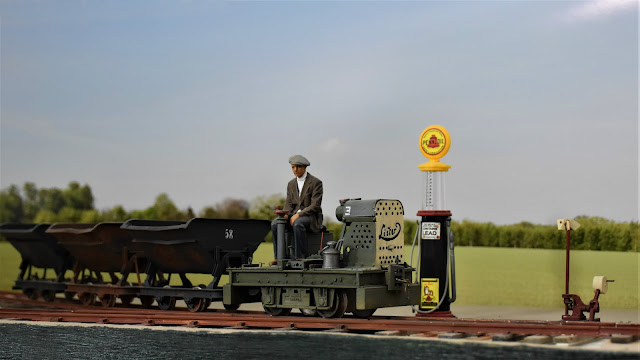
The 16 mm scale indoor Nystrup Gravel layout is far from finished, but it has developed and with a proper background it doesn't look too bad.

On 9. April 2012 I published the first real post on the Nystrup Gravel blog. I had started back in July 2011 with a preliminary announcement that no one probably noticed and that I took a very long time to follow up. When I did follow up, I did it with a history of my little 1/35 gravel line in March 2012. I had modelled seriously in 1/35 scale since the early 2000's building a model of a small Danish gravel company's 600 mm line set in the early 1950's in a rural area. To a large extent the history of this little blog is also a history of Nystrup Gravel and below I take a look at some of the milestones for the blog and my model railway.
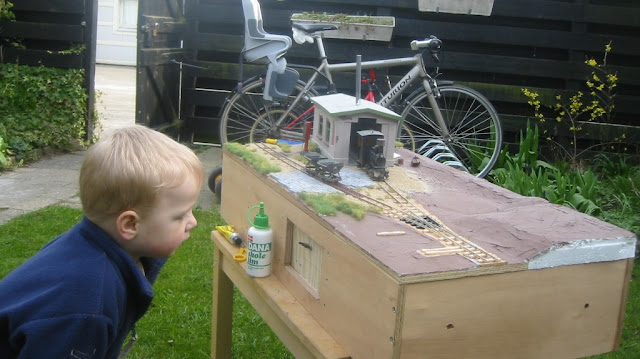
2004: Long time before the blog materialized Nystrup Gravel was developing slowly. My first 1/35 scale module under construction in my garden with my son looking pretty interested. While he never developed a serious interest in model trains, my Nystrup Gravel universe kept expanding.

The first post in 2012 was a short fictional history of the gravel line's history creating an outline of company, line and environments. It's a post I have updated often as I adjust and expand the history of the little line - usually because I want to create an excuse for a new modelling project and to put it into context. The historical aspect of Nystrup Gravel has always been highlighted with old newspaper clippings, company documents and archive photographs. In early 2014 I got worried that some readers would misenterpret everything as historical facts and I wrote a short disclaimer admitting it's all made up by me and not real history. I was fighting 'fake news' even before the term was in widespred use!
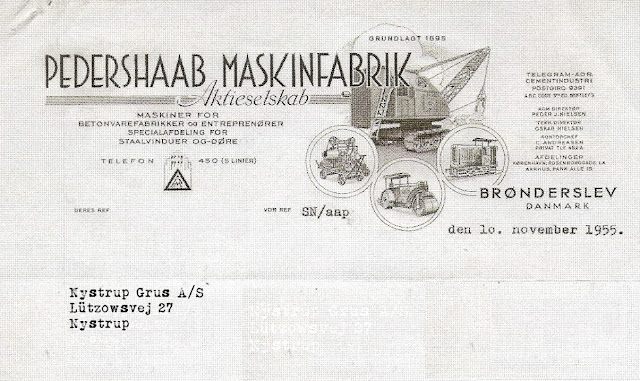
With published letters like this I found it best to inform the blog's readers that I am making up history when I write about Nystrup Gravel. A company of that name never existed in reality.

The first 'real' post was on a braked skip  built from parts from two Scale Link kits. I managed to build two trains of 6 skips each from Scale Link kits in 1/32 scale. All skips were sold when I changed scale. At least one of the buyers is regularly running the skips and it's comforting to know that my old models are still of value to someone. 
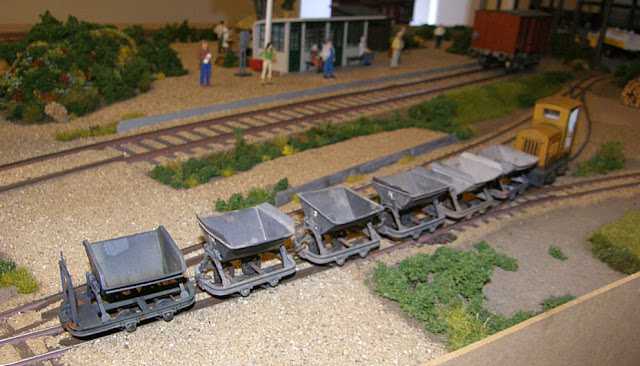
The skip (numbered '12') featured in the first modelling post on the Nystrup Gravel blog is seen here at the rear of a train on the 1:32 narrow gauge line on the NLB-layout owned and built by Lis and Arne Nielsen.

My blog has always been designed with focus on the highly international nature of large scale narrow gauge industrial railway modelling. From 2000 I was exchanging tips and images with modellers all over the world on the Yahoo group FS32NG. My blog builds on that communication and fellow modellers around the globe remain my main audience.  As such I naturally had to write in a foreign language (English) as only slightly more than 5.8 mio people are fluent in my native language of Danish (and only 4-5 of those seriously interested in narrow gauge industrial railway modelling in 1/35 or 1/19 scale). Writing in English seems to have worked out tolerably and I haven't had any serious misunderstandings arise on account of me writing in English, nor have I had any complaints. 

Apparently there is no big difference in size on the 1/35 scale and 1/19 indoor audiences that my blog and modelling is appealing to. Statistics show no great fluctuations nor has there been any signs of growth (or decline) in visitor numbers after I changed scale to 1/19 in 2018. Nevertheless my little blog has now had more that 310.000 page views during its 10 year life.
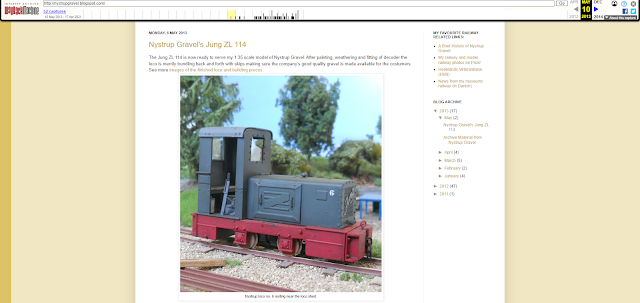
A screen capture from the 'waybackmachine' internet archive showing my 1/35 Jung ZL 114 in a post from May 2013 that was captured by the archive robot. Notice how short the blog archive to the right is. It's considerably longer today - 9 years later. 

In 2014 I moved to a house that provided room for more modules. With a nice and dry 15 sqm wooden annex I was also provided with a good location for setting up the modules for running. The new location also allowed for a certain expansion of both workshop area and number of modules as well as providing a number of possibilities for modelling outside.

Ever since I began modelling the little gravel line I have enjoyed that modules and segments allow me to bring a piece of Nystrup Gravel outside for modelling. Outside modelling is perfectly fine for landscaping and some of the more basic jobs on rolling stock and road vehicles. For fine details I still prefer my indoor workbench. But nothing beats working on a module in the evening sun with a glass of wine and the barbeque heating up. And before you think Danish weather is all bad, we are increasingly experiencing very fine weather with a lovely spring and summer climate, a passable early autumn with only late autumn and winter being depressingly dark, windy, bleak and filled with countless variants of rain. Many posts on the blog have consequently featured photos of outdoor modelling and the traditional projects I bring to the cottage when enjoying my summer vacation there.
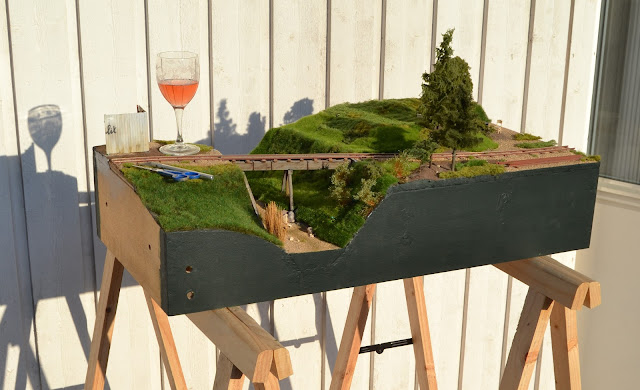
2015: A low evening sun lights up 1/35 scale module 3 while I'm fixing grass mats and vegetation. With a glass of chilled rosé at the ready. One reason for planning a horizontal area the size of a glass on every module. 

In 2018 the Nystrup Gravel enterprise experienced its greatest (until now, at least) upheaval as it changed from 1/35 scale to 1/19 scale also known as 16 mm scale. Being a conservative modeller and having kept to one scale and theme for many years, I increasingly felt I needed to move on to something new. The challenging element of figuring out solutions, overcoming problems etc. wasn't as big as it used to be. Even if I chose to hold on to the Nystrup Gravel universe, the choise to change scale wasn't an easy one. I had grown very fond of the 1:35 scale and models, but I chose to dispose of most of the models. A process that was terminated much sooner that I had anticipated due to a surprising interest from railway modellers abroad. Consequently models from Nystrup Gravel travelled (many in sturdy foam lined boxes) to United Kingdom, Luxembourg, Germany and France besides the few that found new homes here in Denmark.
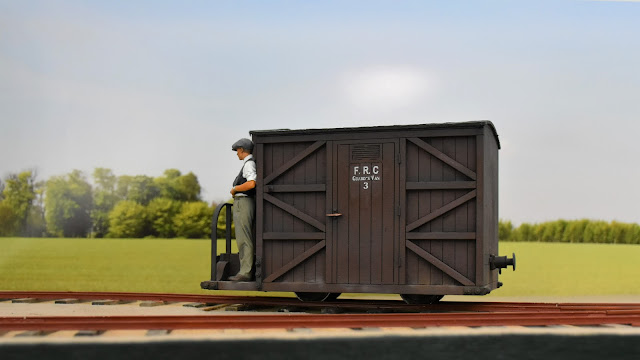
One of the wagons that started the 16 mm scale transformation of Nystrup Gravel. The wagon isn't used much due to being a rather odd vehicle on a Danish industrial railway and distinctively Welsh (and still not fitted with coupling chains). I built the wagon in 2018 and here it is seen fly-shunted with a brake man ready for action.

A subject that has featured often on the blog is road vehicles. In 1/35 as well as 1/19 road vehicles have been playing a role of setting the timeframe as well as the specific location in Denmark. Many industrial railways used the same loco and skips for more than 40 years. Apart from a fresh paint job or more dirt and wear, a train could look pretty much the same in 1979 as it did in 1950. On the contrary, road vehicles changed design almost constantly and are consequently a much better indicator of which span of time my little railway is set in. And with the license plates indicating the car's connection to a particular county the road vehilces are also pointing to the geographic location of Nystrup Gravel.
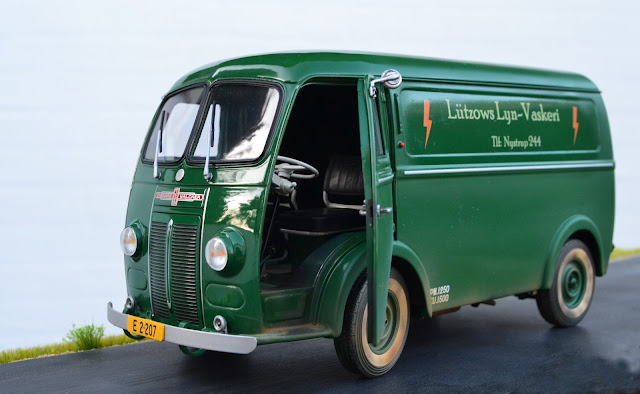
The Chenard & Walcker CHV van from 'Lützows Lyn-vaskeri'. A repainted and relettered 1/18 scale model from the French company Norev. A charming van that sets my Nystrup Gravel layout nicely in the first half of the 1950's and locating it in Sorø county.

Some have asked if writing more than 400 blog posts during 10 years isn't taking an awfull lot of time and distracting me from actually modelling. I like to think it's actually the other way round. Blogging makes me a more productive modeller. Getting off the couch to the worktable is easier when I also have the blog to keep alive and flowing. The more than 250 comments and contributions from readers have been extremely valuable to me. Not only have readers helped point me toward new products and solutions I had never found myself, the comments have also helped to keep my modelling motivation high during difficult times. 
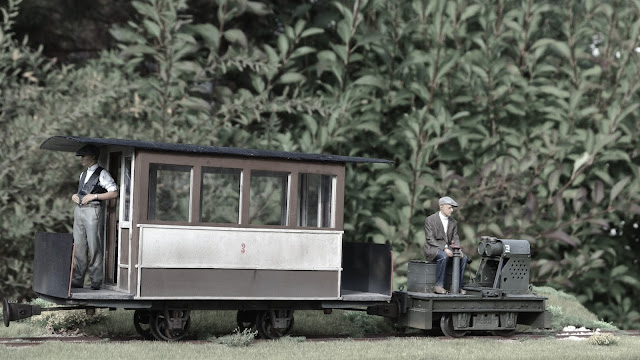
The 1/19 scale photo plank and layout segments are frequent visitors in my garden for both work and photo sessions. Here is an I.P. Engineering Lister R rail tractor pulling a Line Side Hut kit of a 4-wheel Corris coach. Both items suitably rebuilt and adjusted to fit the Nystrup Gravel story. Here in a slightly faded colour photograph.

With the change to a traditional garden railway scale many have asked if I'm planning a garden railway. I'm not. First and foremost because I'm a modeller with an interest in building, painting and detailing. Running trains isn't a top priority and the relatively detailed models I like to build aren't particularly suited for a garden line. Another deciding factor for not claiming garden ground for my trains is that I think a garden railway will end up being too much of a burden to remove once my current house is set up for sale. It may take many years, but I can't imagine myself struggling with dismantling a garden railway at 80 or even worse my children having to level their father's garden line in order to sell off the house. People looking for a house with an established garden railway isn't a significant portion of Danish house buyers. An indoor layout is quickly chopped up and disposed off. This may all sound a little terminal, but as I'm only in the beginning of my 50's it should take a while before there will be a need for chopping up Nystrup Gravel.
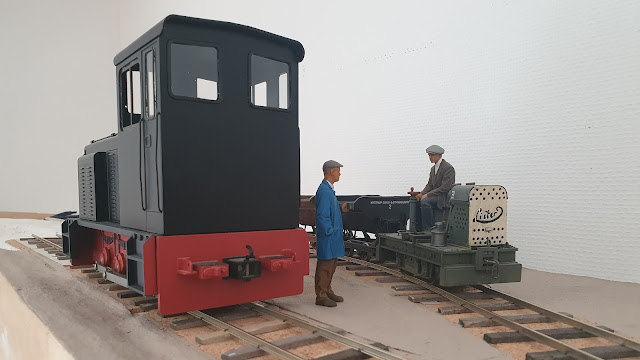
Nystrup Gravel's smallest and largest locomotive posing with crew chatting. The Baguley-Drewry is currently dismantled for rebuilding, detailing and repainting.

I have many plans for Nystrup Gravel in the years to come. Not another change of scale, but perhaps a larger room can be claimed for the layout, allowing for it to expand a little. I hope a relocation to a bigger room will make it possible for me to fit in a small part of the line and a little more landscape in addition to a fiddle yard. It will probably last a few years before the plans materialize. There are lots of other jobs to do, though. Landscaping the current layout hasn't progressed much and a lot of work is waiting. There is also an urgent need for more locomotives and that is one area where I will prioritize some energy very soon. 

This is the complete 1/19 scale Nystrup Gravel layout as it looked in early Autumn 2021. That's all there is so far.

Regarding blogging I haven't planned for any substantial changes. I have been considering a Nystrup Gravel Facebook profile, though. Short texts and images on Facebook could perhaps work as lead ins to the longer posts on the blog. With better lighting equipment acquired I may also begin working a bit more with video. As with all other things railway modelling related I'm a slow worker. Don't expect changes soon!
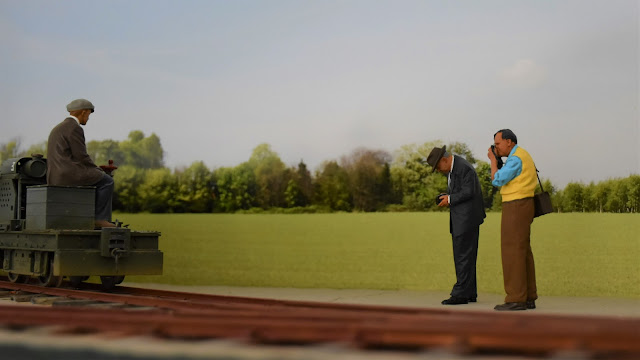
Hopefully the equipment and development at Nystrup Gravel will continue to attract enthusiasts. The company's history will be further explored and I wonder if the blog will be able to celebrate its 20. birthday?

Thursday, 2 December 2021

International Model Railway Day

I have recently learned that 2. December is 'International Model Railway Day'. Why we need a particular day to celebrate railway modelling and why it has to be in December where everyone (well almost) in the Western World is completely engulfed in preparing Christmas I have yet to understand.

With average modelling skills a lot can be made without support from the large manufacturers of model railway equipment: Nystrup Gravel's little Lister railtractor pushing the company's old coach along the track with a worker posted as lookout. Everything created on the basis of products from very small businesses, fellow modellers and basic materials.

I like railway modelling as a pastime, but I couldn't care less if young people would rather have another time absorbing interest than small landscapes with trains on them. As long as they learn something and the interest gives them (and hopefully many others) joy in life, they might for me choose wind surfing, chicken breeding or volunteer to help social disadvantaged citizens. (The latter activity may even be preferable to railway modelling).

The only ready to run-model locomotive I own. Now it's been completely disassembled to be rebuilt as I like to have individualized models on my model railway.

Railway modelling is a hobby and some hobbies disappear as society changes. Stamp collecting is in an obvious crisis (at least here in Denmark where no one hardly ever posts a letter), pigeon racing has seen better days and railway modelling is a star that probably did shine brighter years ago. Many from my generation or older, find joy in railway modelling but it's obvious that recent generations have other interests and only a limited likelyhood of getting into railway modelling, at least while they are young.

If need be I can even manage without metal rail profiles. My first experiment with wooden rails. 

I know there is an industry depending on producing modelling equipment to make profits and clubs needing new members to run and maintain huge model railways. As I buy very little from the traditional railway modelling trade I could probably continue modelling even if Märklin or Bachmann should stop trading. Consequently I'm letting the national federation of model railway societies in Denmark, the big clubs and the trade make their contribution to railway modelling's survival as a hobby. I have a new figure to paint.

Wednesday, 1 January 2020

Railway Modelling

I'm celebrating New Year with a special blog update about railway modelling. Not the usual type of modelling. This time it's the type of modelling that actually involves models. Yes, real living human beings in scale 1:1. And real full sized narrow gauge industrial railway equipment.


It's 1962. Faxe chalk quarry is visited by several models and photographers in a quest to show the latest fashion in open air. Here a model has climbed into skip 362, one of Faxe chalk quarry's large 785 mm gauged wooden side tipping skips.

Two modelling colleagues in front of an excavator bucket, the heavy machinery contrasting nicely with the 1962 fashion's call for narrow width dresses.
Despite an intensive search for more of the same kind of modelling on narrow gauge industrial railways I haven't found any. It seems that the fashion business wasn't too keen on narrow gauge railways anyway.

10 years or more before the above shots were taken, an amateur photographer had the opportunity to catch four young ladies posing on a 600 mm gauge 1930's model Pedershaab loco. Again it's a chalk quarry only this time near Mønsted.
The cut of the dresses is more practical in this shot. The ladies seem to be having a good time nevertheless. Is that grandad lurking in the background making sure the girls are alright? The loco's cab is most likely a local addition to a standard open topped PM-loco.
I look forward to a new year full of challenges and accomplishments with the kind of railway modelling done with knife, wood, soldering iron in a scale 19 times smaller than the real world. I wish every reader a productive 2020 modelling wise.

Thursday, 12 December 2019

Nystrup Gravel in Print

Nystrup Gravel is mostly living a quiet existence in my study and online, being mostly shared in a language foreign to me, English. Just recently my modelling adventure has been mentioned in a small Danish modelling magazine being distributed to members of one of the oldest railway modelling societies in the kingdom of Denmark. Established in October 1945 the society is still active modelling in 0 gauge.
Front page of the magazine 'Train 60'. The model of Aarhus Central Station is an impressing model in 1:45 scale. 
A brief history of Nystrup Gravel and several very nicely reproduced photos are included in the 3 page article. The article also deals with my change of modelling scale and there is even a small portrait of me and my railway career combining modelling, heritage railway activity and my real job for a railway contractor.
Two pages spread out on the floor. The large photographs are nicely printed.

Factually there isn't much in the article that hasn't already been treated in detail here on the blog. The difference is the nice style that the article's author has managed to add both in and between the lines. And the fact that the information about Nystrup Gravel is delivered directly to some very talented modellers, of course. The author is Nils Bloch, a Danish writer with several books on his CV, a range of university degrees as well as years of active service for railway preservation.
Nils Bloch's latest book about a small Danish standard gauge light railway line. A book packed with facts and countless stories from the line's everyday life until closure in 1968.

Tuesday, 30 October 2018

A New Beginning for Nystrup Gravel

Having built models in 1:35 scale for more than 15 years, creating my little piece of a Danish 1950's gravel industry's narrow gauge railway, it's now time for a change. Not of  theme, period or company, but of scale. In the coming years I will be building locomotives and rolling stock from Nystrup Gravel in 16 mm scale - 1:19,05. Currently I don't know if I'll build a small indoor layout or perhaps use a corner of the garden. Time will tell. What is important is that my motivation for the new scale is high. I'm looking forward to new challenges.
One of the pleasures I have had in 1:35 scale has been the mix of different materials and cooperation with other modellers. The skips are from Hesketh & Snoodyk, the loco is 3D-printed fitted on a BullAnt with decals from a friend in Denmark and etched builder's plates from a German modeller. The bridge is completely built from scratch.

Nystrup Gravel No 2 is pulling an empty train to the pits while No 1 pauses outside the shed. It's easy to populate a layout in 1:35 with detailed figures. It's the painting that's hard!

Schöma-locomotive being transported on a heavy trailer. An absolute abundance of road vehicles are available as kits in 1:35 scale. I have had much fun building and rebuilding plastic and resin kist fitting the needs of Nystrup Gravel as well as other companies and individuals in the town.
I'd never thought I'd be leaving 1:35 scale, but despite my conservative modelling attitude, keeping to one scale and theme for many years, I felt I needed to move on to something new. Even if I'm holding on to the Nystrup Gravel universe, the choise hasn't been an easy one. I've grown very fond of my 1:35 models, but will now begin a process of disposing of them as keeping them in boxes in the loft isn't a viable option. I will gradually offer some of the models for sale either here or on some of the forums I'm a member of.

I have even had the joy of building several excavators for Nystrup Gravel. My Ruston & Bucyrus is a resin kit from Accurate Armour. As on all my models I added a few details.  

The large Fowler was Nystrup Gravel's first diesel locomotive. I bought the 1:35 model from a modeller in Australia.

The joy of building modules is that one can bring them into the garden. Photograph them, enjoy them while barbequing or building on them outside as I have done a lot in recent years. Here is a Daniel Caso coach outside the shed one late evening.

1:35 has been a great scale for me and has brought me much enjoyment. I hope more modellers will discover the many possibilities the scale offers. It's a great scale for scratchbuilding, manufacturers are increasingly offering railway related products in the scale and regarding figures and road vehicles 1:35 is way ahead every of the other larger scales. Opportunities are almost endless.

The evening sun is setting as the last train of the day bring fresh gravel from one of the pits.
Should you have an interest in a particular model feel free to contact me with a proposal on price. You are welcome to mail me at the company e-mail nystrupgravel@gmail.com 

Friday, 28 July 2017

Module Finished (1/35)

The bakelite factory module is now finished (well as finished as a model railway ever gets). This afternoon I took advantage of one of the last days of my vacation to install wires and switches for the lights in the buildings. The switches and 12 V socket were arranged on the front of the module.

While the module gradually evolved towards finishing last summer, a few 'bald' spots still remained. These were taken care of this nice summer evening while I enjoyed the working lights in the buildings.
As the sun sets there is apparently still activity inside the buildings.

One guy went home after turning out the lights.

Finally the last guy at Banke's Bakelite closed up as well.

A driver and his Bedford O having a little break in front of one Nystrup's small industries.The little 600 mm. gravel line running between factory and parking area is almost invisible.

In the yard of Pedersen's Machine Shop a lot of work must have gone into a thorough clean up. No trace of all the metal parts usually strewn everywhere. Shortly after this photo was made, stuff began to build up again.
Being a slow modeller I seem to take forever to get the smallest of tasks done. I'm glad I only build a small module at the time. A whole layout would probably feel quite overwhelming.

Sunday, 29 January 2017

Langeland Narrow Gauge (1/35)

As I mentioned last week a few of my sacks with foundry sand had been sent to Langeland. On the island of Langeland a small machine shop was a regular user of Multisand. From the SG station a narrow gauge railway took the sand to the works. I have been fortunate to receive some images from Langeland showing just such a transport.

A narrow gauge train at the small halt Broløkke. The railway usually carried firewood. In the background a short standard gauge goods train. Photo: Arne Nielsen.
Loco driver Valde Marsen during some shunting at Broløkke. Notice the difference in size between the small Henschel DG26 and the brand new Danish State Railway's type Mh shunting engine. A lonely spectator apparently finds the narrow gauge railway the most interesting. Sacks of Multisand can be seen in the 3 plank open wagon. Photo: Arne Nielsen.
 
Crossing the large road between Pløresø and Arnborg. The crossing was a dangerous place and I hope the bicyclist will be able to avoid crashing into the little train. Besides foundry sand to the machine shop the train carries cement and tarpaper. Photo: Arne Nielsen.

En route the train stops at a siding to unload cement and tarpaper at a construction site. The row of new houses being built can be seen in the background. Notice the level of detail: There are mushrooms under the pine trees! Photo: Arne Nielsen.
Here's one of the sand trains at Nystrup Gravel. While the foundry sand was a profitable product, the deposits of sand were limited. By far the most usual train on the line was a train of skips loaded with gravel.

Despite modelling in a scale and theme not shared by many I'm lucky to have a few good friends modelling in 1:32/1:35 I can cooperate with. We send each other tips and share parts when we can. Most important we provide inspiration to each other and I benefit greatly by being 'pushed' to the modelling bench when I see the progress done by my friends. I have shared images from Arne's narrow gauge railway before. You can see more on this site from time to time, but be warned: most of it is Gauge 1, 1:32 and standard gauge!

Thursday, 17 November 2016

A Local Hobby Shop in Berlin

While in Berlin this summer I came across this fantastic shop front of a hobby shop. Apart from childrens' toys the shop carried a lot of plastic kits, railway books and a wide selection of Märklin model railway items inside. But most amazing to me was the old fashioned shop front with neon signs in old Märklin design. If you fancy a visit yourself, find the shop on Wilmersdorfer Strasse 157 in Charlottenburg, Berlin or visit the shop's website.
The costumer at the door seems to hesitate. No need for that as there is plenty of nice stuff inside! I must confess I didn't buy anything. But as I model a Danish narrow gauge industrial railway in 1:35 scale I didn't expect a lot of things relevant to me.

The iconic neon signs over the shop front windows. Must look wonderful when lit in the dark.

Wednesday, 14 September 2016

Back to the Work Bench (1/35)

After a week long break I'm now going back to modelling. I have been quite busy with paper work for the heritage railway you probably know I'm involved with. To be allowed to operate, any heritage railway in Denmark will have to meet certain standards and document their safety procedures. It's a lot of paper work even for a small narrow gauge railway. With most of the work done I should now be able to do a little modelling again.
Not paper work for a narrow gauge heritage railway's traffic permit, but an image of busy civil servants from the time when Nystrup Gravel had a hard working industrial railway - with hardly any government concern over the possible dangers involved in skips and gravel transport.
 Conveniently enough I received the decals for my Opel bus the other day. I'm now in the process of varnishing to prepare the model for the markings - which are spartan and modest. 
Here is the small decal sheet for my blue and orange 1:35 Opel bus. Produced by 'Skilteskoven' in Odense for a modest sum of money. Can't wait to fit them to my model!

Wednesday, 26 August 2015

The Spares Box - What Would I do Without it? (1/35)

In many of this blog's posts I have mentioned that I used a part or a decal from the 'spares box'. Most modellers have one or more boxes or drawers where parts that go unused in a kit - or rescued from a scrapped model - are kept for future projects. Plastic sticks from lollipops, packaging band and parts from old printers are also held in my boxes. Some of my friends even donate odd plastic bits or kit parts they know they'll never use for my supply of spares. Thanks a lot!

This is why a spares box is a good thing. Missing and broken parts in a resin and white metal kit replaced with objects from the spares box: steering wheel from a scrapped ZIS-5 lorry, levers from an Italeri Bedford QL-kit while the little box is the unused battery from ICM's Opel Kapitän.

I wouldn't last long without my collection of spares. My cardboard boxes have saved a project so many times I have lost count. Sometimes I can even complete a little project with nothing but parts from the boxes, as when I built a load for my Fordson 7V lorry. Recently I found a 1:35 concrete telegraph pole among my spare parts - just what I needed for a new factory building. You'll have a hard time finding a post on this blog that doesn't mention parts from the spares box.

Found in the spares box. With a little modelling putty, a few minutes of sanding, three new brass insulators, some paint and I had a new feature for a little factory complex.

Unfortunately it is not easy to guess what one might need for a future modelling project. As a consequence I have tended to save close to anything in my boxes. Even though I often use parts from the boxes, they seem to grow endlessly. As I obviously cannot keep everything I recently cleaned out one of my boxes. I didn't have the nerve to get rid of much, but I judged some parts (über extraordinarily) unlikely to be of any use and I got some parts of their kit sprues. That created a little more space in the box.

Two card board boxes with spare parts. The parts are not sorted or filed in any particular way. If I need a part I simply start looking!

The great thing about the spare parts is that they are basically free, as they would otherwise be destined for the dust bin. Good for my wallet and a step towards 'sustainable modelling´ where no part is allowed to go unused?