Sunday, 30 June 2024

TU7 and Closed Goods Wagons in 1/87 Scale

The packages from Ukraine keeps arriving, bringing my supplies for a little diorama of a mining location in Eastern Europe to new levels. This time I shopped at Retro Trains Models in Kryvyi Rih in the Donetsk region. The order took no more than a week and a half to travel from Eastern Ukraine to Denmark. Parcels from the UK often have longer shipping time.

Two goods wagons, a TU7 and a Tomytec drive unit have arrived on my work table.

RTM produce high quality resin kits of 1520 mm standard gauge Ukrainian locomotives (that would be broad gauge to us) as well as an expanding series of narrow gauge loco and rolling stock. The level of detail is quite high and the TU7 kit has more parts than my 1/19 Lister (even when counting all the parts I added myself). I think that illustrates the level of detail possible in the RTM kits. If I will manage to apply all those very tiny parts neatly remains to be seen!

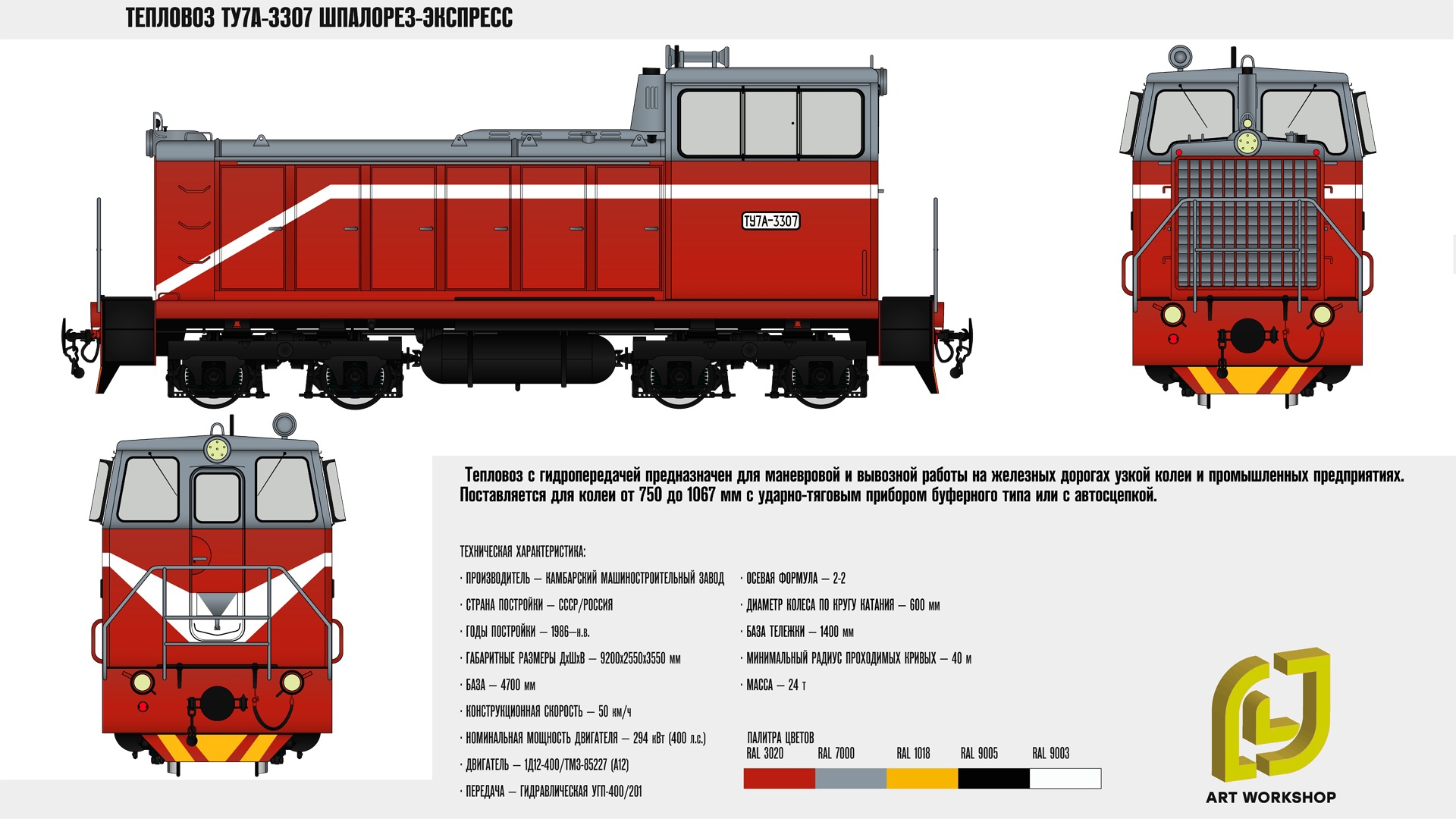
Data sheet of a TU7A. Despite being in Russian, most railway enthusiasts should be able to interpret the info and see that this is not a tiny narrow gauge locomotive. 

The TU7 type was developed in 1971/72 at the Kambarka Engineering Works to replace the company's older 750 mm gauge locomotive types TU4 and TU2. The type is still in production at Kambarka, although in an updated version (TU7A) introduced in 1986. The production of TU7 reached well over 3000 units and several hundred were exported to e.g. Cuba and Vietnam. The TU7 was designed for use on on gauges ranging from 750 mm to 1435 mm and standard gauge. Cuba received standard gauge TU7s while the Vietnamese ones were 1000 mm. Like the TU4s at Western European heritage lines, a TU7 has also found its way west, as the 603 mm gauged Brecon Mountain Railway in Wales acquired TU7-1698 from Latvia in 2010. The TU7 is a versatile construction fitting in on railways with gauges varying from 600 to 1435 mm gauge! 

TU7 at Tver Construction Material, 180 km northeast of Moscow. As usual the gauge is 750 mm. Photo: Ilja Semonof.

The RTM TU7 is a resin kit with a high level of detail and designed to fit on the Tomytec TM-21. While the recently bought TU4 will be a static model the Tomytec drive unit will enable me to build a functional locomotive. 

A simple design with single end cab. Fault free casting with no flash at all. Test assembly of a few major parts shows a perfect fit. 

Well packed kit with an impressive decal sheet.

To accompany the TU4 and TU7 a few wagons was in order and I selected two closed goods wagons built by Demikhovo Engineering Works (Демиховский Машиностроительный Завод, ДМЗ) in Demikhov near Moscow. The plant was founded in the Soviet Union in the 1930's building machines for the peat industri including bogie hoppers by the thousands. Today the company is Russia's main producer of EMU's. The prototype goods wagons seems to be a type built from 1965 and into the 1980's with a load capacity of 20 t. From photographs and a single drawing the RTM kit looks very close to prototype. As the TU7 kit the wagons have lots of fiddly parts and a high level of detail.  

The RTM kit's upper body test fitted on the combined frame and floor part. A rather long 750 mm gauge goods wagon, but still a quite small model (compared to what I usually build).

The sudden investment i H0e models of Soviet prototypes is not a sign of a change of scale, but merely meant to be an enjoyable side show allowing me to model another field of interest in a much smaller scale. The Nystrup Gravel project moves on in its usual slow pace hampered by the usual time limiting factors of life (not that I'm complaining). This week I have been working (10 minutes or something) on track detailing before adding vegetation and ballast. 

Close-up of a Peco point partly rebuilt with wooden sleepers. As I rebuilt the two points, the frog sections kept their plastic sleepers. On one of the points the sleepers have now received a layer of medium grey paint. The upper right part has also had a thin wash of raw umber oil paint. Further weathering will hopefully help the plastic sleepers to blend into the rest of the hand built track on the layout.

Monday, 10 June 2024

TU4 Diesel Locomotive in 1/87 Scale

My little adventure exploring Soviet narrow gauge in 1/87 scale continues to haunt me. I have aquired Peco H0e track and points for a small diorama, mining equipment in H0f and now a resin kit of the classic Soviet narrow gauge diesel locomotive TU4 has arrived from Ukraine.

TU4-2620 at the Peregruzochnaya 'Station' on the Pishchalskoye peat line in Kirov Oblast, 2018. Photo: Igor Kaisin.

As the PD-1 draisines the TU4 is a kit from K-Model in Kyiv via eBay. 'Haven't Ukrainians more urgent things to do than making resin kits of narrow gauge locomotives these days?' many may ask. Yes, there is a war going on, but Ukraine is a huge country and the economy is still working despite difficulties like temporary power shortages and more than a million men and women in the military. Pubs were open in Britain during the 'Blitz' so obviously miniature models can be produced in Ukraine during wartime, too. 

The TU4 kit is unmotorised and cast in good quality resin. There are small amounts of flash to be cleaned away, but nothing a semi-experienced modeller can't handle. I have found no warping or air bubbles in the castings. Most of the parts are quite small as can be expected in 1/87 scale. I'm quite sure it is possible to motorise the model using a N-scale diesel mechanism. My plans for the kit have yet to be formulated, but most likely the kit will end up a static model on a siding on a small mining diorama.

The kit's cardboard box. Although sold by K-Model it says SK Trains on the box lid.

The box contains three zip-lock bags with parts.

The major parts laid out on the cutting mat. The loco is shorter than a logging bogie in 1/19 scale!

Loco body and frame. Nice clean castings with very thin flash to be removed.

The first TU4 was built in 1962 (first prototype built 1958) at the Kambarka Engineering Works (КМЗ, Камбарский машиностроительный завод) in the Soviet Union. 3210 TU4 locomotives were produced until 1974, most of them in the Soviet standard narrow gauge 750 mm. The locomotives were (and are still) used on many narrow-gauge railways serving industries like logging, peat extraction and minerals. Regular narrow gauge lines in Ukraine had TU4 locos in service into the beginning of the 21. century.

TY4-1417 in a configuration looking very much like the K-Model resin kit. Image from USSR, 1970's.

With a production that size a number of changes occured to the design and 4 major subtypes of TU4 locos has been identified. It's mostly subtle external differences, like window shape, placement of headlights etc. and due to rebuilds and swapping parts at repairs there are often many individual differencies. The K-Model kit seems to be of a mid-production TU4 differring clearly from the first 200 produced and the last 1000, some of which had a TU5 cab.

TU4 production was distributed all over the Soviet Union and lately examples have been exported to vintage railways in e.g. Finland and Sweden. Here is Östra Södermanlands Järnväg's no 21 imported from the Haivoron line in Ukraine and rebuilt/regauged to 600 mm. Here shunting at Mariefred Station in 2023.

The kit parts go back in the box as I currently haven't time for yet another project. But I like to know the kit is safely in my stash for the future. One never knows with small kit companies, particularly those located in countries attacked by Russia.

Sunday, 9 June 2024

Ground Cover Spreading Slowly

Due to a heavy workload at work, I have had precious little time for modelling. My only achievement has been minor work on the ground cover at the bottom of the gradient to the lorry loading ramp. Gravel and used ground coffee was glued down with PVA glue followed by different lengths and colours of static grass. The method I use is as old as modern railway modelling and I have described it before. Next up is ballasting the first point, something that will take several types of work.

Ground cover is slowly spreading. Only to be mostly covered again with vegetation.

Most of the gradient to the lorry loading ramp now has a first covering of static grass. 

More productive modellers will probably laugh at my speed of progress. But I am not in any great hurry to finish my little layout. I want to finish it and I like to be productive, but I have work, volunteering and a family to take care of. Modelling comes last. 

Practicing another of my hobbies: running a 5 km long 700 mm narrow gauge vintage railway. Ballast raking in progress. Frequent raking of the ballast helps keep the weeds at bay without pesticides.

Friday, 31 May 2024

More Modelu Figures

In early May I received new Modelu figures to test as drivers in Nystrup Gravel's Fowler diesel. A lot more was in the package and I also mentioned the figures being sorrounded by supporting web of thin posts. They help the figure to remain firmly supported during printing and initial curing. Here is a closer look of how Modelu figures are looking before the supports are removed.

The two additional figures from the Modelu double figure sets 11208 and 11219 figures and a fox from set 31101. The maze of support sprues are evident. Unfortunately the right figure's right thumb seems to have suffered a fracture not even the supports could avoid.

The supports are easy to remove and shouldn't keep anyone away from investiong in one or several of Modelu's excellent large scale figures. I would count the Modelu figures as one of the most influential additions to 1/19 scale railway modelling. Modelu's figures are light years better than the usual caricature garden railway figures. They may be good enough in the garden, but on a small indoor layout like mine... never!

Apart from the loco crew I had the following sets added to the package:

0134 'Man with spade'

0148 'Man Kneeling'

31101 'Foxes'

'Man with spade' will be a good representation of track worker having been at work tamping a few sleepers with the spade. 'Man kneeling' could be representing a mechanic tending to a problem on a loco with a few tools laid on a piece of old cloth beside him.

Apart from the selected loco driver and a single fox the rest of the figures go back in a cardboard box for storage. I have plenty of other projects.

Sunday, 19 May 2024

Playing Trains on the Porch

We've had lovely weather in Denmark for the last few weeks. While I like to model outside, I rarely run trains outdoors. Having finished a day's programme in the garden I fancied playing trains on the porch. I got out some Loco Remote straight track panels for a short length of track. The Lister was an obvious choice for propelling a U-tub steel skip back and forth. The birds were twittering and I had a glass of chilled rosé ready.

A small 1/19 scale model train on my porch.

The warm and quiet late afternoon had a good light and I took the chance to make a short film. Besides the sound of birds there isn't much sound on the film. I like the movement of the track panels where they cross some of the unevenness in the porch. It looks exactly how real track panels move in reality.


While I love to model and build stuff it's quite nice now and the to just sit and watch a simple train move back and forth on a length of track.

Friday, 10 May 2024

New Figures

Risk of overstaffing at Nystrup Gravel? It could be the case with the latest delivery from the busy 3D printing maternity clinic in Bristol, also known as Modelu. 6 new employees were included in the package. The figures were accompanied by two foxes to add a little life to the area behind the loading ramp. 

One of the new figures resting againgst the footplate of the Fowler (with added detail parts yet unpainted). Small remnants of the 3D printings supports can still be seen here and there on the figure.

As with earlier purchases from Modelu I've not planned getting all figures ready for service at once. The most pressing need is to get a driver figure for the Fowler locomotive. The idea is to select one or two figures from the two crew packs to be converted to a Fowler driver. I'll probably have to do minor surgery and a little sculpting as I did a lot when I modelled in 1:35 scale.

Modelu crew pack 11208 for the small England engine. Photo: Modelu

Modelu crew pack 11219 for quarry Hunslet engine. Photo: Modelu.

After a switft production time of one week and a one week postal and customs trip to Denmark I couldn't wait to open the package. Safely wrapped in several layers of bubble wrap inside a solid cardboard box the figures waited for me to examine them and test fit them in the Fowler cab. I had a surprise waiting for me. My earlier deliveries from Modelu have been of figures with the 3D printing supports removed. Now the figures are supplied with the complete support structure of a web of thin posts. They help the figure to remain firmly supported during printing and initial curing. The removal of the support posts isn't a difficult task. Only a sharp knife, a side cutter and some time is needed. What surprised me the most is the new level of detail. My 1/19 scale figures from Modelu has been adequate in detail, but I have often been disappointed by weak facial detail, soft and missing detail in clothing and bad demarcation from eg. trousers to shoes. Most of those objections are now gone. I'll be going into detail when I start working on one of the new figures. And by the way: the price has gone down as well!

The right figure from pack 11219 resting his back side on the low rear wall in the Fowler cab. To call him a perfect fit isn't quite true, but it's a close call.

Here the figure is seen from the side.

The left figure from pack 11208 was my second bet on a possible driver figure for the Fowler. He looks good too, but needs something the rest his right arm on. 

Peeking out from the cab. 

I'm quite confident that I now have a decent driver for the Fowler. Adding a little material to the back side of the figure from pack 11219 and adjusting the height (trimming shoes and cap) will obtain a near perfect fit in the cab. And the figure will even be removable and at the same being able to keep its position while traversing bad track (as all track is at Nystrup Gravel).

As for the rest of the figures pictures will have to wait. It's Spring and I'm too busy with the 1:1 scale vintage railway, maintenance of two wooden houses and real work. But one of the Modelu foxes sneaked out and was photographed near the lorry loading ramp.

A Modelu fox in 3D print has crossed the meadow covered by static grass from the photographic rendition of a wood where it usually lives. 


Thursday, 2 May 2024

Timber Bogies From the Archive

The archives from Nystrup Gravel have been mostly preserved by a local historical archive and are kept accessible to the public. Last winter I found a nice photograph from the early 1950's showing the Lister loco with two timber bolster bogies loaded with a large log.

Loco no. 3 picking up a pair of loaded bogies for transport to the yard where a lorry will bring the log to the railway station in Skovby for transport to Sundborg.

Of particular interest is the writing on the log end faintly visible in the photograph. The letters 'SU' marks the log as one destined to go to the Sundborg Sawmill. The sawmill in Sundborg is currently being recreated in 1/87 scale by a Danish modeller and the plans and progress can be followed on the Sundborg Blog. The blog is in Danish only, but the pictures will tell most of the story.