Showing posts with label Narrow gauge history. Show all posts

Tuesday, 13 October 2026

International Narrow Gauge Meet

After having been in Berlin for the biannual railway exhibition Innotrans, I spent time working in my Trondheim office and then went straight to four full days of narrow gauge impressions at the 34. Internationales Feldbahnertreffen in the United Kingdom. The major annual event for vintage narrow gauge industrial railway enthusiasts was hosted by Moseley Railway Trust in Apedale not far from Manchester. Other railways provided support and co-hosted the event.

Moseley loco 29 'Vanguard' (Runston & Hornsby 195846/1939) on the brick tip at Apedale with a train of skips. Just one of many trains running during the four day event.

As usual the event had four days filled with networking, presentations, train rides and visits to usually off limits workshops and storage buildings. All host railways provided plenty of trains, steam, petrol and diesel traction. The weather ranged from very good to decent with very little rain and few clouds (except from the ones made of steam or unburned coal and diesel! The main host was the Moseley Railway Trust with the West Lancashire Light Railway, Statfold Barn Railway and Amerton Railway supporting the event with an extraordinary amount of traffic, locomotives and friendly volunteers. 

'Sybil' (Bagnall 1760/1906) arriving with a passenger train at the main station.

Something I really like: A diesel locomotive shunting skips. Here it is WLLR 36 (Ruston & Hornsby 339105/1939).

As most of the participating enthusiasts are practical people, themselves keeping alive narrow gauge railways, a lot of inspiration is shared. Tips on track building are passed on, a wish for measurements on a particular flywheel is noted and a lot of shoulders padded for the latest achievements on the home railway.  Apart from the networking  a lot of train riding on the host society’s railway is on the programme.

In typical English landscape and autumn light is Statfold loco 'Howard' (Hunslet 1842/1936) waiting to take a full load of European enthusiasts to Statfold main station from Oak Tree Halt.

Statfold loco 'Sybil Mary'  (Hunslet 921/1906) being readied for service.

As usual the event provided a good view into other organisations' methods, collections, track equipment and volunteer base. I made several observations that may be useful on the vintage railway where I volunteer myself. As a modeller I also saw things that I can probably use on Nystrup Gravel and some ideas have begun to develop in the back of my head. 

Going up hill at Apedale is loco 102 (Simplex 60SD754/1980) with a vigilant crew. 

It's morning and a bit chilly, but the three steam locos are hot. They are no. 9 (Hudswell Clarke 1238/1916, 'Jennie' (Hunslet (Statfold) 3906/2006) and 303 (Hunslet 1215/1916). To the left is Moseley loco 104 (Ruston & Hornsby 19287/1940).

Apart from inspiration and 850 images on the camera's memory card, I brought home some self-quarried coal from the upper Apedale seam and books enough to completely overwhelm my rucksack. It was with a heavy burden on my shoulders that I left the 34. Internationales Feldbahnertreffen and the United Kingdom!

Amerton 746 (40SD501/1975) passing the railway's signature tree before reaching the main station on the line.

‘Lorna Doone’ (Kerr Stuart 4250/1922) with a passenger train passing a small lake.

In the coming months I'll probably be burdened a little less on my work and no travelling is planned for the next month. That should leave a little more time for modelling than this past month. I will be working on figures and the Baguley-Drewry. Just so you know what to expect.

Most of the participants assempled for the traditional group photo.

Sunday, 27 September 2026

Modern Narrow Gauge at Railway Exhibition in Berlin

The railway exhibition InnoTrans in Berlin attracts more than 100.000 visitors every two years. I was at the exhibition as part of the team manning the stand through my job in a railway contracting company. Every concievable product and service related to railways are represented at the exhibition and fills the huge Berlin exhibition area completely. On the exhibition ground's own railway yard new rolling stock, locomotives and permanent way equipment stand buffer to buffer. Rarely anything narrow gauge make it here. 2026 was different!
Seldom seen in the Berlin exhibition rail yard: a brand new narrow gauge train!

Among lines of standard gauge locos and wagons a light green three car train was placed on transport bogies. It was the world’s first hydrogen-powered train developed specifically for narrow-gauge operations. A total of 21 trains are being built for three Italian regional operators in Sardinia, Calabria and Sicily. Each car is equipped with a powered and an unpowered bogie, while the 'Power Pack Car' rests on two unpowered bogies. A 3-car train has room for 89 seated passengers and a top speed of 100 km/h. You can check out Stadler's press release here.

The three-car train shown in Berlin was loaded on transport bogies in matching colour.

The first completed train, presented at InnoTrans 2026 in Berlin, was built for the narrow gauge network in Sardinia. Ten vehicles will go to the Sardinia network, 2 for the Sicily line near Etna and the remaining 9 for the network in Calabria. 

A Stadler-illustration of the Sicily version of the hydrogen train with Etna in the background.

Sunday, 20 April 2025

Narrow Gauge In Budapest

When I visit cities abroad I usually try to get a railway attraction on the programme. Recently I was in Hungary's capital Budapest that has a very varied selection of railway features: plain normal standard gauge, trams, Europe's oldest metro, funicular, rack and pinnion line, railway museum and a narrow gauge 'childrens' railway'.

Mk-45-2002 arriving with train at Széchenyihegy station on the Budapets childrens' railway. The loco was built in Romania by the 23. August Works as 1569/1972.

I was fortunate to get a taste of several of the dishes at the Budapest railway buffet, but the 760 mm gauge childrens' railway took first place as it is a lovely scenic train journey through the hills of eastern Budapest that also has great value for non-railway enthusiasts (at least my travel partner said so). I visited the railway back in 2009 and not much had changed since my first visit. The railway was built in 1947 as a pioneer railway, an institution many countries under communist rule was blessed with. Here the young pioneers (besides getting a (un)healthy dose of political teachings) could learn working together running a railway with adults only taking care of the most demanding tasks. That's basically also what is happining on the railway today just without the communist indoctrination.  

The large mosaic above the ticket counter at Széchenyihegy station reminds of the time when the Hungarian flag had to be accompanied by the red banner on a depiction of the young pioneers. The uniforms have changed slightly, but the children are still saluting every passing train with (what to me looks very much) the communist pioneers' salute.

 
Despite visiting in early April two trains were operating on the almost 12 km long railway. Here trains meet on Szépjuhászné station. The train from Hűvösvölgy is pulled by Hungarian built Mk 48.2024.

The railway is a (for a Dane) steep climb from Hűvösvölgy to Széchenyihegy covering 235 meters in height including a horse shoe curve with a tunnel. Absolutely worth a visit.

If you visit the railway museum in the northern part of Budapest to see narrow gauge items you'll be disappointed: I saw only one small 760 mm draisine representing Hungarian narrow gauge railways at the museum. There is a lot of interesting standard gauge things to see (of particularly interest to me was the track maintenance machines and rail cranes). 

The single narrow gauge item exhibited at the Hungarian railway museum in Budapest. Draisine GV 179. 

Budapest is a nice city to visit, rail transport is extremely cheap, has good regularity and while very few foreigners understand Hungarian, Hungarians understands English just fine.

Saturday, 17 September 2022

Swedish Inspiration

With narrow gauge railways in scarce supply in Denmark it's an obvious choise to visit the great neighbour Sweden that has a much broader selection of railways in different gauges. As I'm engaged in building a red wooden building I also wanted to study how windows are built into simple industrial type wooden structures. Off I went with a group of enthusiastic friends.

Loco 21 on the 600 mm gauge Östra Södermanlands Järnväg west of Stockholm shunting in front of the workshops. The loco has been regauged from 750 mm and extensively rebuilt since arriving from Ukraine.

The 4 day tour took me to railways with gauges varying from 1435 mm over 1093, 1067, 891 to 600 mm. Most of it pure heritage stuff, but we managed a few visits to standard gauge installations relevant to the professional side of my railway life.

Diesel loco 'Ohsan' visiting the Östra Södermanslands Järnväg from the Ohs Bruk heritage line. Originally built as a steam loco (Motala Verkstad 148/1894) it was rebuilt into a diesel loco by Kalmar Verkstad (36/1937) and stil going strong. Near Hedlandet halt.

A lovely train of four wheel closed vans on Mariefred Station, Östra Södermanlands Järnväg, 600 mm gauge. Didn't I once see a blurry image of two closed vans from Nystrup Gravel? I think so...

White framed window in red wooden building. Just how the windows in my building for Nystrup Gravel will be fitted.

While it was the 600 mm lines we visited that provided the most applicable inspiration, many of the other lines in larger gauges were also full of atmosphere and lovely sights all surrounded by plenty of trees. 

An absolutely gorgeous railcar in shiny black in front of a standard Swedish railbus and trailer on Marielind Station on the 891 mm gauge Uppsala-Faringe heritage line. The line having a respectable length of 33 km. and a very good track standard.

With Sweden being a neighbouring country, with a long shared history with Denmark and a language easy to understand, it's no surprise that it's a country I really like to visit. Danes and Swedes have a lot of things in common, although we (as neighbours tend to) often focus on the differences.

Humor brings together people. Here is a handle on the small motor trolley 'The Comet' on Östra Södermanlands Järnväg. The bottom position says 'Stop' the next up position is 'Running' and the upper position simply 'Panic'!

Having reached Denmark again I'm trying to find time to fit window frames in my relief building, I will probably not get far, as I'm getting ready for a week in Berlin and the railway exhibition InnoTrans 2022 (nothing to do with heritage railways or modelling, but part of my job in a railway construction company). 

Wednesday, 22 June 2022

Old Colourized Image

These days several websites offer the possibility to upload a black and white image, klick a button and download a colourized image. Often not very realistic or well done, but quite fun after all. In the bad old days colour images were usually obtained by colouring a black and white image. The colourizing was done by humans (usually women) in a process that required a lot of care.. The quality could be quite good, but very few images were made this way as the price was high. In Denmark I have seen the proces predominantly used for colourizing aerial photographs of farms to be displayed in the property's living room.

A hand colourized photograph of a small farm on the Danish island Bornholm. Photo: Bornholmske bondegårde.

I tried colourizing a digital image myself. As the image was in colour, I first had to make it black and white. I then uploaded it, the computer did its thing and I'm now in possession of the image below. There are several free online services where you can colourize a digital image. The quality is mixed and sometimes the same website gives you one good image and an awfull one. I guess it depends on original image and on the artificial intelligence-system that the site employ to 'guess' the colours of the b/w image.
Next to the line east of Nystrup. The image looks suitably hand colourized and faded. Definately one of the better attempts.

I used the colourizing service https://deepai.org/machine-learning-model/colorizer

Friday, 1 April 2022

Hard Work with Skips

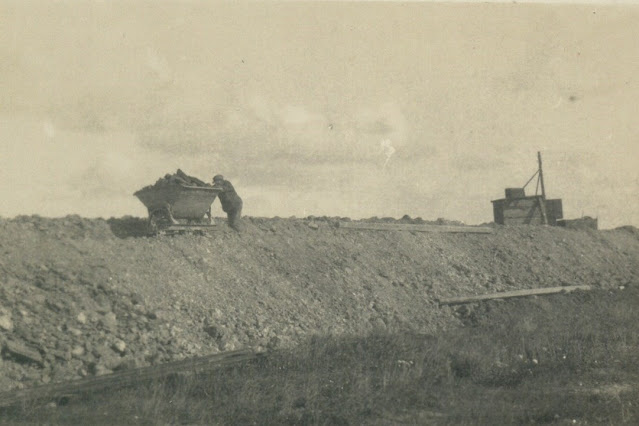
With an interest in narrow gauge industrial railways and the experience of pushing loaded skips by hand I have a lot of respect for the men who earned their meagre salary from working with skips. What I find an attractive and active hobby was perhaps their only chance of providing for a family.

Working like that day after day wasn't healthy. It's no coincidence that the life expactancy was somewhat shorter for a worker 100 years ago. Photo: Bøvling Sognehistorisk Forening og Arkiv B1496

On my Nystrup Gravel layout hand pushing of skips is not something I have ambitions of modelling. I have retrieved some of my daughter's Schleich horses from storage in the attic. A static display of one of Nystrup Gravel's horses is certainly a possibility if I succeed in making a proper harness. 

Sunday, 6 February 2022

Railway Enthusiast Wearing Suit

Back in August a package with two railway enthusiasts arrived and I have already finished one figure that has seen action in the Nystrup yard. The remaining figure that I have now started working on is Modelu item 1607 'Photographer with Box Brownie'.

Leaning over his camera, the second railway enthusiast is being prepared for Nystrup Gravel.

The figure is wearing a classic two-piece suit, tie and hat. I decided to paint the suit in 'Black Grey' from Vallejo to make the figure a contrast to the far more colourful mate. The description of the figure mentioning a 'box brownie' almost certainly refers to the well known Kodak Brownie sold in huge numbers for low prices. Even in the large scale of 1/19 the box camera is looking pretty much like a lot of other contemporary and later box cameras like the Agfa Syncho Box that Nystrup Gravel chief mechanic Thorleif Petersen used for his railway photography.


German advertisment for the Agfa Box. So easy to use, a child can do it.


Upper right corner shows a 'noble gentleman's suit' of same cut as the railway enthusiast's. Page 28 from the winter catalogue, 1951 from 'Daells Varehus' in Nørregade, Copenhagen. The catalogue provided the backbone of the company's huge mail (old fashioned letters) order business.

A modern day reader may question if the early railway enthusiasts really were that well dressed when visiting motive power depots and other dirty railway locations. A lot of images from several countries confirms that and none better than photos of enthusiasts from the UK. They were some of the earliest to perform the hobby and seem to have had more film to spare than continental enthusiasts, even allowing them to photograph each other. Many images from the 1950's show men of all ages to be usually dressed in suit and tie when visiting and photographing railways.

Very well dressed members of the Railway Photographic Society, captured by founder Maurice Earley in 1937. Photo: National Railway Museum, York.

In a previous blog post I complained about the front of the camera being devoid of any detail. I added the lens and the two small windows for the viewfinders from small dics of plasticcard punched with my little punch and die set. When I inspected the figure before painting, I discovered that the jacket had some front damage that I repaired with putty and repeated sanding. That out of the way, I then worked on the line between shoes and trousers that have been a weak point on almost all my 1/19 scale Modelu figures. Besides minor sanding of chin, upper back and shoulders, the figure was then ready for a wash with how water. When dry it was primed and the first layer of dark grey brushed on.

The classic enthusiast in action with camera fitted with basic front detail. 

For the faithful reader that have kept up the hard work reading this post to the (almost) end, I have included what is often mentioned as the majority of 1950's Danish boys' first glimpse of a female in underwear: a lingerie page from that same 1951 catalogue. Definately suggestive!

Friday, 4 June 2021

Nystrup Lister 1952

A new image of Nystrup Gravel's Lister R has surfaced. Writing on the back of the image says '1952'. The image is from the gravel works in Nystrup. With the naked ground it must be autumn as the trees still carry their leaves.

Nystrup Gravel loco no 3 on the way down from the loading ramp in Nystrup. The driver must have been quite skillful to propel 3 loaded skips up the ramp with the Lister. No 3 was usually only used for light shunting in Nystrup or the occasional light permanent way train.

I know of only two other original photographs of the Lister railtractor in service at Nystrup Gravel. I showed one of the images on the blog last year. The new image shows the Lister in basically the same condition as the 1950 photo. It's apparently even the same driver driving? 

The prototype photographs available from Nystrup Gravel makes a good source of inspiration for my modelling and I find it very satisfying to recreate some of the original scenes on my small 16 mm layout.

Tuesday, 12 May 2020

Track Research

My preliminary test of wooden track has led me to further investigations into wooden track and early metal track designs and usage. It has been very interesting and provided me with a fuller understanding of the development of the railway track to the current design. I have also been surprised by how the vocabulary and track part designations dates back to the very earliest railways and plateways. Two books have been particular helpful.
A snapshot of the two books providing a wealth of info on track history and development. As a coincident the most recent newsletter of the Danish Industrial Railway Society had an article on wooden track.

Much info is packed into the above books. "Early Wooden Railways" by M. Lewis deals with the railways' ancient ancestors; wooden railways in primarily mining service. In "The Railway - British Track Since 1804" Andrew Dow takes over as mechanical traction on the tracks was introduced.The books really are a winning combination. As companions they describe tracked transport systems from the middle ages to modern high-speed lines today. I recommend both titles to any enthusiast with a serious interest in railway track.

Wednesday, 5 February 2020

Pedershaab Variety

I haven't had much time for modelling lately. But I have managed to adjust the 'sit' of the plasticcard frame on the power bogie by fixing layers of plasticcard cut offs inside the frame. There may still be some minor adjusting to do, but the frame's height above top of rail is almost right. The frame's edges and corners were worked with sanding sticks and sand paper. The rounded appearance of a Pedershaab frame is now almost there. The ballast weights to be fitted on each end were made from plasticcard and Miliput. Sanding produced smooth rectangles of fairly square shapes.

Pedershaab frame with ballast weights still unglued. The skip to left has had three holes drilled in the bottom. The holes were drilled to test how best to drill through the quite tough metal body.
The D-series of Pedershaab locos I'm building a model of all seem very uniform at first glance, but once you get closer they exhibit all sorts of differencies. I'm not building one particular loco but a wartime built model FD with large ballast plates resembling the preserved M 2 on HVB.

Below is a series of images from a user of a large number of Pedershaab locos clearly showing their variety and important work. During the German occupation of Denmark 1940-1945 every part of society was lacking ressources. The Danish cement producing industry was cut off from its usual coal supplies and what little Germany could provide didn't meet the needs. Consequently the cement industry sought new types of fuel. In the large peat bogs south and north of the cement industry's epicenter in Aalborg the companies began harvesting peat to burn in the cement ovens. The peat extraction was a huge operation using a large number of machines, considerable manpower and both narrow and standard gauge railways.
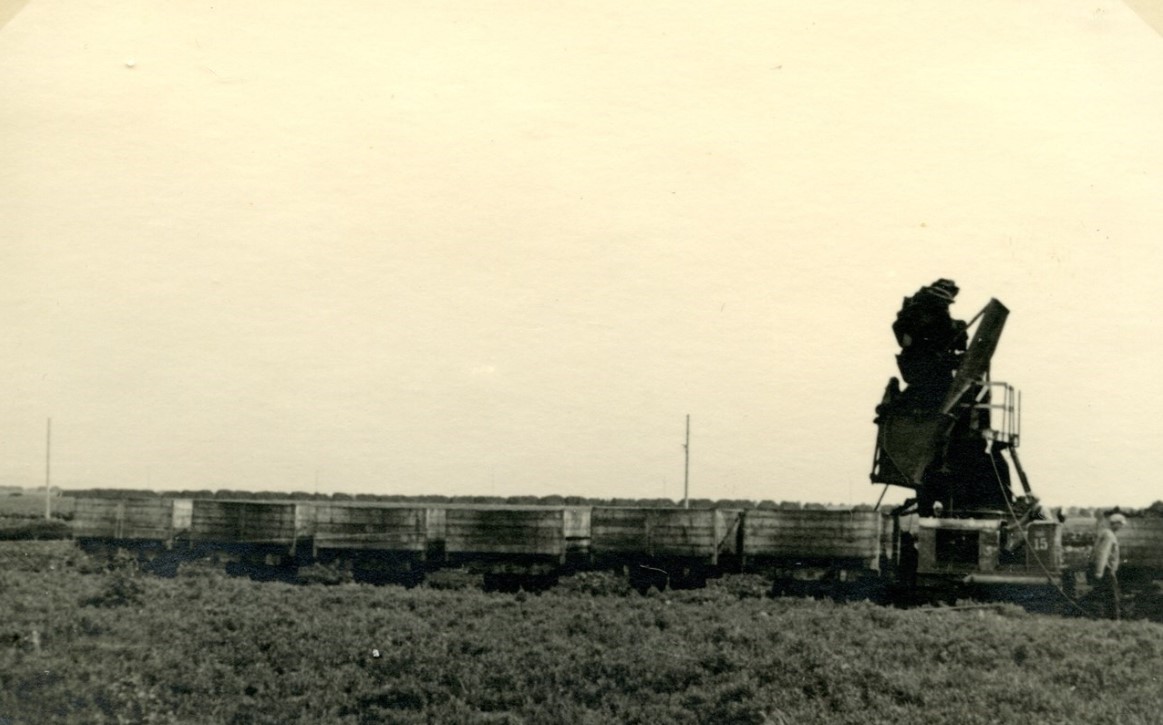
Open cab Pedershaab no. 15 positioning wagons for loading at a peat excavator. No 15 was powered by natural gas to save on the limited amount of petrol available. The gas was extracted from local underground deposits by drilled shafts and delivered in pressurized tanks to the users.
Workers getting a ride on a Pedershaab on their way to work. Could I perhaps completely skip modelling the top part of my Pedershaab and just fit 12-14 scale figures? 

Pedershaab fitted with a snow plough posing between heaps of peat. Notice the black out fitting on the front lamp. It was war time and a nationwide black out was in force to make navigation for allied bombers as difficult as possible.

Pedershaab no. 13 equipped for fire fighting duties. No 13 is fitted with netting over the exhaust to prevent igniting the highly flammable peat bog. The netting couldn't catch every ember from the exhaust pipe, but was reasonably effective preventing bog fires.  

Pedershaab no. 3 with pressurized tank for natural gas and closed cab on the large ramp used for loading lorries as well as standard gauge wagons.
Last image is a great line up of 15 700 mm gauge locomotives. 13 from Pedershaab and 2 locos from Kastrup Machineworks. All locos seem to be fitted with natural gas fueled engines.
The series of images can be found on the great public Danish online archive arkiv.dk to be viewed for free. The website is a great ressource when modelling Danish prototypes.

Tuesday, 5 November 2019

Visiting Clausthal

When in Germany and not too far away from Clausthal any sane person with my name knows where to go! Considering that the town of Clausthal-Zellerfeld in addition is home to the oldest mine shaft steel headframe in Germany and on the UNESCO world heritage list, a visit was quite unavoidable. I was on my way home from the international narrow gauge meeting in Ilmenau.
Mine shaft headframe from 1876.

The Ottiliae Schacht mine shaft headframe is not only the preserved oldest in Germany, but also appears to be the oldest in Europe. The headframe once served a mine shaft almost 600 m deep. The shaft served workings of lead and zinc and was taken out of service in 1930. Since the workings served as water resevoirs for water turbines. That use terminated in 1980 and in 1984 the shaft was filled with concrete and the buildings turned into a museum. A 600 mm line connects the museum with the former railway station in Clausthal-Zellerfeld.
B 660 tandem locomotive from Betrieb für Bergbauausrüstungen, Aue. The type was built from 1980 to 1990 when the production was closed down due to the collapsing economy of DDR. With a weight of 5.5 t it develops 8.4 kW.

Lots of interesting stuff to explore on the tracks near the headframe. To the left a compressed air powered locomotive.

The B 660 pulling 3 wagons having just left the mine museum.

The Clausthal area is hilly and mountainous and the B 660 has a tough job ahead of it, when returning uphill to the mine shaft. The mine museum is located in a very beautiful area

Tuesday, 3 September 2019

Inspiration - No Bicycling!

With access to a large number of images from Danish industrial railways I'm flooded with scenes, structures and vehicles begging to be modelled. Currently I'm looking for inspiration for my future 16 mm scale module. In that proces I stumbled over an image from Vindø Brickworks.
No bicycling! As if any sane cyclist would want to cycle uphill into a clay pit? No matter what the image is full of character and atmosphere. I'm quite sure I will try to incorporate a model of the sign on a post near the track on my model. Photo: IBK archive.

Vindø Brickworks is one of the few surviving Danish brickworks. Founded around 1850 it is today a modern fully automatic brick factory with a production of 25 mio bricks a year.
Aerial photo of Vindø Brickworks 1946. A lovely Fordson 7V is visible just where the ramp meets the white building in the upper right corner of the image. The ramp took the narrow gauge track onto the 1. floor of the building where clay was tipped for mixing and homogenisation. Image nks_04499 in the Royal Danish Library.
The brickworks' narrow gauge line was rather short, but ran through a beautiful wooded area close to the fjord. On the aerial image from 1954 below there seems to be a building halfway between the brickworks and the clay pit. Probably a dry storage building for loaded trains of skips.
Thanks to the Royal Air Force photo mission in May 1954 we can see Denmark from above in 42.700 images. Here Vindø Brickworks and clay pit.
A long story just to help remind myselt that I must remember to include the sign in my planning of my coming 16 mm scale module.

Tuesday, 13 August 2019

A Danish Hudson-Hunslet

I have been fortunate to be able to acquire what must be a small part of the Nystrup Gravel company archive. In previous posts I have shown some of the old documents. The documents, newspaper clippings and pictures have been a huge inspiration for my modelling.

Due to the overwhelming succes of Danish manufacturers of small internal combustion narrow gauge locos foreign locomotives are comparatively rare in Denmark. We have had a fair selection of German locomotives from Gmeinder, O&K, Jung and Deutz. British locos, on the other hand, were few and far between. In a small advertisement from P. C. Petersen, Aalborg a brand new 3.25 ton Hudson-Hunslet with 20 hp is mentioned being for sale in 1947. There is currently no evidence as to where the Hudson-Hunslet loco went from P. C. Petersen, but the demand for locos was great after the war. It's unthinkable a brand new loco wouldn't be a prized item for any gravel company or contractor.
The advertisement is a scan from the newspaper 'The Engineer' 18. July 1947 found in a box with Nystrup Gravel documents. It also mentions 20 new British 600 mm gauge skips. Nystrup Gravel had British skips but bought from the Danish dealer V. Spøer.

In the Nystrup Gravel archive I have also found half a list of the company's skips. The British skips are simply mentioned as being of 'British type'. From photos we know they were of the Hudson 'Rugga' type. The list of skips was originally mentioned in a post in April 2013.
A torn off upper half of a list of skips at Nystrup Gravel dating from 1951 and 1952. Six skips of British type are listed numbered 47-48, 50, 52 and 54-55.