Friday, 7 September 2018

Renault Station Wagon

When I ordered the Chenard & Walcker van I also bought a 1:18 Renault Juvaquatre model 1951 station wagon. The station wagon was only introduced in 1950 a considerable time after the sedan Juvaquatre was launched in 1937! The model is made by French company Norev. As a metal diecast model it is quite heavy and makes a very sturdy impression. In this large scale diecast models can be made quite detailed and while small scale diecast models often have unrealistically soft details I don't think it is too obvious in 1:18. The car has interior detail, three opening doors and the bonnet opens too, revealing a detailed engine. 
A French model of a French car: the Renault Juvaquatre station wagon.

The car has good ground clearance and with the ability to carry some extra cargo in the rear compartement I thought the car would fit in as the local veterinary's vehicle. Being located in a rural area a veterinary would have enough work to do in Nystrup. 
Open driver's side front door showing interior detail.
 As opposed to the Chenard & Walcker van the Renault has no French features to be removed to fit in around Nystrup. Only the license plate will have to be exchanged with Danish ones. A slight toning down of chrome parts, and a light weathering of underside and lower sides as well as a few bags in the cargo area and the car should be ready for service.

As part of my testing if 16 mm scale is a viable scale for me to work in I have ordered a figure. In my view figures are a weak point of the scale, and the majority of the figures in the scale would never make into my ownership. I'm looking forward to see the figure as it may be a deciding factor if 16 mm scale is going to be a future scale for me.

Wednesday, 5 September 2018

British Skips for Nystrup Gravel

Nystrup Gravel bought brand new skips a few years after the 2. World War. The old skips had taken a beating during the occupation when traffic on the little gravel line had been very heavy. The new Hudson skips came from Great Britain, in those years the primary supplier of things mechanical to Denmark. After the war it was difficult for Danish businesses to get permission to import goods from abroad. Nystrup Gravel must have been lucky to be allowed to buy new skips.
Two new skips. Here seen in the state they had developed to after a few years of service.

The new skips are to 16 mm scale and quite a bit larger than those I have previously built in 1:35 scale. In an earlier blog post I finished the basic work on the frames. While working on the frames I had decals made that matched those on the 1:35 scale models.

The skips in the garden before I started the painting proces.
The skips from Binnie Engineering are basically sound models with a potential for adding details. The edges of the skip bucket seemed rather wide to me, so I sanded them down a bit and rounded off the corners. I shaved off the rivets on the end edges and added a plastic card reinforcement strip. The rivets were glued back on again with AC glue. It was exiting if I would be able to keep the loose rivets from disappearing and I managed to reuse all but two.

On the frames I added bolts to the brackets holding the axle boxes to the frame and the grease bolt on the front of the axle boxes. I used bolts from TichyTrain. The coupling horns are modified nails bent appropriately and with the heads filed in shape.


I primed the skips with my usual black primer and decided to apply decals and weathering directly on the primer. The weathering was applied in several stages consisting of acryllic and oil paint, pastel chalk and graphite from a soft pencil.
Skips with decals and preliminary weathering applied.
The two Hudson-skips with buckets tipped. The holes drilled in the bottom of the body is barely visible. Any sensible skip owner drilled holes to allow rain water to seep out.
Nystrup Gravel skip 50 in 1:35 and 1:19 scale side by side.

Friday, 24 August 2018

Ffestiniog Early Brake Van

As part of my 16 mm scale testing programme I also bought an I P Engineering laser cut Ffestiniog early brake van. Totally irrelevant in a large scale 1:19 Nystrup Gravel scene, but a wagon with lots of character and charm. Perhaps it would even qualify as 'cute'. Having seen it at Boston Lodge on my recent visit to the Ffestiniog Railway, I couldn't help buying a kit. I shopped at I P Engineerings own website and found the packet on my door step a week and a half later.
The I P Engineering kit built, but still unpainted. Not my model, but an image from I P Engineering's website.
The majority of the parts are from laser cut wood. The wood is nicely cut and only minute tabs keep the parts attached to the surrounding fret. Metal wheels and brass bearings are included as well as a few white metal castings that make up detail parts like buffers, iron strapping and door handles. Decals are included in the kit.
The complete kit laid out on the garden table.

The kit is designed for the frames including wheelsets to be permanently glued to the body. That is not a design that appeals to me. I like my models to have the running gear and the body as separate parts. In 1:35 scale that has helped when servicing the models, doing repairs or replacing broken parts. I assume that approach will also prove helpful in 16 mm scale. Very little work produced an easy to disassemble model.
Added wooden stop to enable the body to rest on the frames.

I made a hole for a bolt to enable the frames to be separated from the body. In the other end the buffer assembly keeps the frames firmly in place. Here the wheels' running surfaces have been masked off in preparation for priming.

Current status on the brake van. Size comparison with an in-progress Hudson skip.

Sunday, 12 August 2018

Cars for 16 mm scale

As I'm quite fond of road vehicles I couldn't think of testing a new scale without checking out if any cars are available. I was pleased to find that you can get nice pre-assembled road vehicles in 1/18 scale that can be used in 16 mm scale. Most of the available models are modern or high-powered cars of no use to me. Nevertheless I found a rather good selection fitting within a 1950's Danish scene. I ordered a pair of nice, characterful French cars because I fancied them and was able to get them to a nice price.
Straight from the box to the garden for a snapshot.

One of the cars arriving in a very large box from France was a diecast Chenard & Walcker type CHV van from 1946. I'm not sure there ever was such a van in Denmark, but the design was taken over by Peugeot and vans of that type were seen on Danish roads. With a modest rating of 26 hp the van was most likely not exactly fast.

The manufacturer of the model is the French company Norev. Being made from metal it is probably the heaviest model I have ever owned! Despite being diecast and pre-assembled I find the detail very satisfactory. It must be the large scale that enables such fine detail to be achieved on a pre-assembled model right out of the box. The rear view mirrors on the doors look a little toy like, but I think a washing with diluted black oil paint will bring out the detail on the mirrors a little better.


I love the way the front doors open!
Most 1/18 car models probably end up as collectors' items in their boxes or in a cupboard. My lovely green van will be fitted with Danish license plates and I will try to remove most of the things identifying it as a French registrered car. It will probably receive some light weathering to enhance realism. It will make it completely worthless on the collectors' market, but I'm a builder and user of models, not a collector.

Saturday, 11 August 2018

Skips in 16 mm scale

With an arm encased in plaster 16 mm scale projects have a clear benefit over my 1:35 ones. They are larger and more manageable with my restricted use of my left hand. Consequently, I have been working on two skips, as that is a type of wagon I’m quite well used to handle.
When I bought decals for my GVT wagon I also had two Hudson skips from Binnie Engineering sent to Denmark. I added metal wheels to the order. Both to enhance future running qualities and to provide some weight. Looking through the plastic bag of kit parts upon arrival revealed a simple, but basically sound kit, although with a little less detail than my 1:35 Hudson skips from Scale Link.
Instructions for the kit and the metal wheel set.
My first task was to fill some large sink holes in the skip frame. Located in the curved end parts of the frame, the holes needed several passes with putty and files to be filled. I drilled out the axle boxes for the brass top hat bearings, fitting them with AC-glue. Then I glued the 14 parts together, leaving out the plastic coupling horns. 
With putty and sanding I managed to remove the sink holes in the frame.
I intend to improve the skips a bit, adding detail on axle boxes, improved representation of couplings and enhance detail on the edges of the skip body.
Two Nystrup Gravel skips ready for detailing and final assembly.

Thursday, 2 August 2018

Vacation And Obstruction

With decals arrived I could get on with the finishing touches on my 16 mm scale Glyn Valley wagon. A wagon I thought would make an easy and relaxing build to last me through my vacation. It even outlasted my vacation as I'm currently not completely fit modelling wise. During reroofing one of my sheds I had an incident on a ladder leaving me with a broken left wrist. No lasting damage, but enough to limit modelling for a while.
The decals from 'Dickies Decals' are in place. They work well with my usual decal solutions MR Hobby decal softner and setter. I chose no 157 on one side and no 130 on the other. You never see the wagon from both sides at the same time, so why not create some variety! I have picked up the trick from David Taylor and his 0-16.5 Charmouth layout.
Decals were fitted before my little accident and since I have been enjoying weathering the little wagon. Small heaps of granite chippings have been glued inside the wagon. Interior as well as exterior have been weathered with oil and acrylic paints, chalk colours and graphite from a soft pencil. It may need a little additional treatment, particular on the inside.
The 157-side of the Binnie Engineering wagon. I'm not in any way certain if there ever was a GVT wagon numbered 157 or 130. The kit was bought as I felt an urge, not after any deliberation at all or because I know anything about the GVT.

The 130-side of the wagon. A simple design fit for a primitive industrial railway.

The inside still needs some attention to blend the different colours together.

I'm sure wagon 157/130 isn't my last model in 1/19 scale. I like the physical presence of the large models and the relatively large trade support. I notice that the level of detailing isn't always to the standard I'm used to in 1:35 but then there's something for myself to add. Currently I have a Ffestiniog brake van in progress and two Hudson skips unassembled.

Monday, 16 July 2018

Different Scales

Having for the past 15 years or more not built a kit in an other scale than 1/35-1/32 I'm currently going completly bonkers. I have bought kits in two other scales. One well-known from many years ago (1/87) and one completely new (16 mm scale). I'm I loosing the interest in 1/35? Probably not as I know of a range of other modellers happily modelling in many different scales, so why not me?
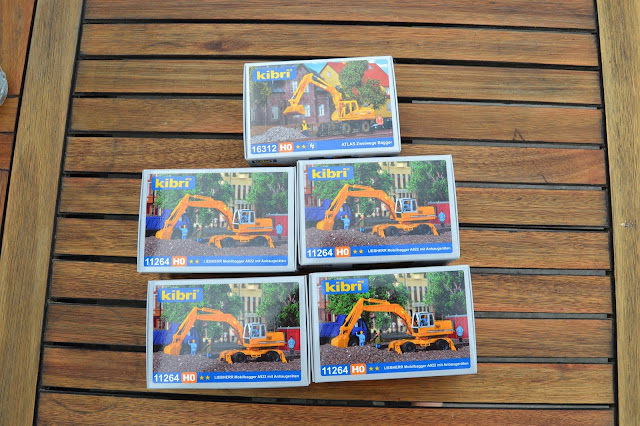
1/87 two-way excavators for a project at work. Being a modeller can't be kept a secret for ever when working for a railway contractor. Some of these will probably be rebuilt with larger cabs and buffers. Proper painting and custom made decals will definately be needed.

16 mm scale Glyn Valley Tramway wagon from Binnie Engineering bought in the museum shop at Tywyn Wharf station. It sort of just fell into my hand together with a number of books.
While the small excavators are destined to become an Autumn project at the real work table, the granite wagon seemed like a good project for the cottage, where I can ony bring the most necessary tools.

Having never built anything in 16 mm scale and never even seen a 16 mm scale model in real life, I had no idea how large the wagon would become once it was assembled. I was baffled by the size! The wagon was close to four times larger than a 1/35 skip.

The parts were moulded without any flash and fitted well. Without any fuss the model was assembled in no time. I had planned to simply assemble and paint the model, but once started I couldn't help distressing a few planks and removing a bolt head and drilling a hole to represent a missing bolt. Decals were ordered (and a few additional 16 mm scale wagons mysteriously 'fell' in the shopping cart as well).
Most of the parts in place. My usual size rubber bands would hardly reach around the model without splitting!

Primed and with the first layers of paint on. As the Danish Summer has produced more than two months' worth of delightful warm days and evenings the model has been built exclusively out of doors.
Work on the wagon will now have to await the decals arriving. In the meantime I'll be checking out the great garden railway blog about the Peckforton Light Railway. I wish you all a happy Summer!